

Rumor has it she pawned her ring to keep his company alive. That company became Nvidia, now worth trillions. And he cheated on her.
Nvidia CEO Jensen Huang has admitted to cheating on his wife, Lori. That has a lot of people asking the same question: if the Huangs divorced in California without a prenup, what would happen to one of the largest fortunes in the world?
The short answer is that the affair matters much less than you might think in terms of what Lori is entitled to. The timeline of their marriage matters much more. And that rumored pawned ring raises a surprisingly important legal question about what happens when one spouse puts their own money into a shared asset.
Let’s walk through it.
Does cheating matter in a California divorce?
California is a no-fault divorce state (Cal. Fam. Code §2310(a)). Neither spouse has to prove wrongdoing to end the marriage. It is enough to cite irreconcilable differences. That also means an affair, on its own, generally doesn’t earn the other spouse a bigger share of the property. As painful as infidelity is, California courts don’t look at marital misconduct to divide assets as a punishment.
There’s an important exception. Spouses owe each other a fiduciary duty when it comes to community money. (Cal. Fam. Code § 721). In addition, spouses may not unreasonably gift community property to another person without the other spouse’s written consent. (Cal. Fam. Code § 1100). If one spouse spent marital funds on an affair, such as gifts for the mistress, couple trips, hotel stays, or even housing for someone else, the other spouse may be able to recover that money in the divorce under these principles. Depending on the circumstances, a court can award the wronged spouse half of what was misused, and in cases involving fraud, oppression, or malice, potentially all of it.
The takeaway: in California, cheating (alone) doesn’t change the math of how much a spouse gets. Paying for the affair with marital money can.
Why the timeline of the start of Nvidia matters more than the affair
California is a community property state. Under that system, property either spouse acquires during the marriage is presumed to belong to both spouses equally. (Cal. Fam. Code § 760). Property owned before the marriage, along with gifts and inheritances received by one spouse, is generally that spouse’s separate property.
That’s why the Huangs’ timeline is so important. They married in 1985, and Nvidia was founded in 1993, eight years into the marriage. Because Jensen acquired his ownership interest in Nvidia while married, that interest is presumed to be community property. Without a prenup, postnup, or other written agreement changing that, the community estate is divided equally in a divorce.
Compare that to a founder who starts a company before getting married. In that case, the business generally begins as separate property, and the court’s job becomes figuring out how much of the company’s growth during the marriage came from community effort. That analysis can get complicated. Here, it’s much simpler: the company was built inside the marriage.
What a 50/50 split of Jensen’s stock could look like
First, a clarification: a divorce wouldn’t give Lori half of Nvidia. It would potentially give her half of the couple’s community interest in Jensen’s stake, which is still one of the largest fortunes on the planet.
That community interest isn’t limited to his founder shares. Stock grants and other compensation Jensen earned as CEO during the marriage are generally community property too. When equity awards are only partially vested at the time of separation, California courts typically use a time-based formula to separate the portion earned during the marriage, which is shared, from the portion earned after separation, which generally belongs to the employee spouse.
Shares may be divided in kind or awarded to one spouse
Would Jensen have to sell billions of dollars in stock to pay Lori her share? Not necessarily. California courts have ways to divide stock without forcing either spouse to cash out.
The first way is dividing the shares in kind, meaning a portion simply transfers into the other spouse’s name. In In re Marriage of Behrens (1982) 137 Cal.App.3d 562, the Court of Appeal upheld the decision to divide shares of a closely held corporation in kind after weighing liquidity, transfer restrictions, and tax consequences. (Dividing in kind means splitting the asset itself instead of converting it to cash first). It further explained that dividing in kind is okay, but the circumstances of each divorcing situation matter.
The second way is awarding the asset to one spouse. When economic circumstances warrant, Family Code section 2601 allows a court to award a community asset to one spouse, on conditions it considers proper, to achieve a substantially equal division. In practice, one spouse could keep the shares while the other receives other property or compensation, rather than requiring a sale to a third party. For a founder who wants to keep voting control, that option can be valuable, but it only works if there’s enough other property to balance the scales. That’s a tall order when most of a fortune is tied up in a single company’s stock.
Either way, transfers between spouses as part of a divorce are generally not taxed at the time of transfer under federal tax law, so neither spouse is forced to sell just to complete the division.
The pawned ring: what happens when you put your own money into a shared asset
Now for the detail that has everyone talking. There’s an unverified rumor that, in Nvidia’s early days, Lori pawned one of her rings to help keep the business afloat. We can’t confirm that story. But it raises an excellent legal question that comes up in divorces all the time: what happens when one spouse uses their separate property to help acquire a community asset?
In California, Family Code section 2640 can give that spouse a right to reimbursement when the community estate is divided. If the ring was Lori’s separate property, for example, an engagement ring she received before the wedding or a piece of jewelry she inherited, and the proceeds went toward acquiring a community asset, she may be entitled to be reimbursed. That reimbursement would come on top of her half of the community property, not instead of it.
But “I helped keep the business afloat” doesn’t automatically win the claim. A court will generally look at three things.
Proof. The spouse seeking reimbursement has to trace the money back to a separate-property source. That can be done with records like a pawn ticket and a bank deposit. As you can probably guess, proving where money went more than 30 years ago is a real challenge.
Purpose. Not every payment qualifies. Contributions that “count” for reimbursement purposes under 2640 include down payments, payments for improvements, and payments that reduce the principal of a loan used to buy or improve the property. Using separate funds to buy into a company, such as acquiring stock that becomes community property, can qualify. Covering ordinary expenses like rent or payroll generally does not count, and the statute specifically excludes interest, maintenance, insurance, and taxes.
Paperwork. The right to reimbursement exists unless the contributing spouse waived it in writing. An informal understanding that the money was “for the family” isn’t enough to give it up.
Then comes the catch. Reimbursement under section 2640 is generally dollar for dollar, without interest and without any adjustment for growth in value. That means that if a ring was pawned for $2,000 in 1993, the reimbursement claim may be worth about $2,000, even if the company it helped save is now worth trillions.
The good news for Lori is that this doesn’t change the bigger picture of her divorce settlement. Her 50% stake of Jensen’s stake is still on the table. This reimbursement information is likely more relevant to people who don’t have a huge stake in one of the world’s biggest companies.
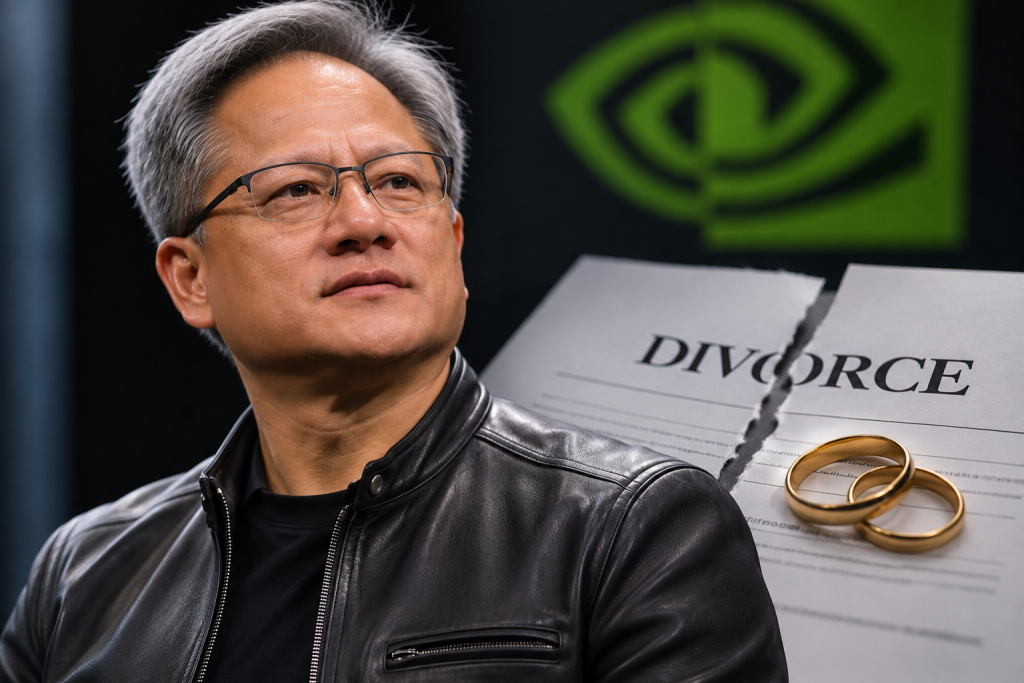
Image credit: AI-generated illustration inspired by Jensen Huang.
What a prenup could have changed for Jensen and Lori Huang
A prenup lets a couple decide these questions on their own terms, instead of leaving them to default state law and a judge decades later.
For a couple in which one spouse might start a business, a well-drafted prenup can address whether a company formed during the marriage remains separate property or becomes shared property. It can also address how future stock grants and equity compensation will be treated.
Just as important, a prenup can spell out what happens when one spouse puts their own money into a shared asset or a business, such as pawned ring money. Without an agreement, California’s default is generally reimbursement of the qualifying dollar amount. With an agreement, a couple can choose something different: the dollars back, the dollars plus interest, or an actual share of the growth. For a spouse who sacrifices early, whether that’s savings, an inheritance, or a ring, that choice can make an enormous difference.
Prenups aren’t only about protecting the founder. In many situations, the spouse making early sacrifices is the one who benefits most from having expectations in writing.
To be enforceable in California, a prenup has to meet specific requirements, including being in writing and signed by both parties, abiding by the 7-day rule, full financial disclosure, voluntariness when entering into the agreement, and the opportunity to work with independent legal counsel. (Cal. Fam. Code §§ 1610–1617).
The bottom line
In a California divorce without a prenup, the affair itself likely wouldn’t change how the Huangs’ property is divided. What matters is that Nvidia was founded during the marriage, which makes Jensen’s ownership interest presumptively community property, subject to an equal split. This means Lori gets half of whatever Jensen has. And the rumored pawned ring is a reminder that sacrifices made early in a marriage don’t automatically translate into a share of what they helped build.

Susan Scherman is a family law attorney, mediator and consultant, with extensive expertise in helping individuals and couples navigate Prenuptial Agreements, business issues, and divorce.
0 Comments