Congratulations on your engagement in the beautiful state of North Carolina! If you are considering entering into a premarital agreement, here are the requirements you’ll have to meet in order for that agreement to be deemed valid in North Carolina.
Prenup basics in North Carolina
A premarital agreement (also referred to as a prenup) is defined in North Carolina as an “agreement between prospective spouses, made in contemplation of marriage and to be effective upon marriage.” (N.C. Gen. Stat. § 52B-2). Plain English, please! A prenup in NC is an agreement two future spouses make before getting married. They can include topics like property division, alimony, inheritances, gifts, rings, taxes, pets, bank accounts, and so much more.
The law that governs prenups in North Carolina is known as the North Carolina Uniform Premarital Agreement Act (NC UPAA). This Act was adopted in NC from the Uniform Law Commission in an effort to make prenup laws more consistent across the states (and just over half of the states have done so). The NC UPAA tells us what makes a prenup valid and enforceable and what can (and can’t) go into a prenup. Let’s dig in a little deeper…
What are the legal requirements for a North Carolina prenup?
To make sure your prenup stands up in court if it is ever challenged, you need to follow all the rules in North Carolina to create a valid and enforceable prenup. Here’s what you need to know:
Requirements:
-
- Put the agreement in writing and make sure both spouses sign it. (No verbal agreements, please!)
- While notarization isn’t strictly required in NC, it’s a good idea to get it done to create an added layer of protection to your prenup.
- Make sure both spouses enter into the agreement voluntarily (no duress, coercion, undue influence, etc.).
- Make sure both parties provide fair and reasonable financial disclosure (each party must share their assets, income, debt, and inheritances with the other).
- The prenup must not be unconscionable (i.e., overly unfair or one-sided).
- The prenup must not include clauses against public policy or against the law.
>>See more of the fine print on North Carolina prenup requirements in N.C. Gen. Stat. § 52B-3 and N.C. Gen. Stat. § 52B-7.

Do I need a lawyer for my North Carolina prenup?
North Carolina does not explicitly address whether independent counsel is required via statute. However, there is case law to suggest that having independent counsel for a North Carolina prenup is not a prerequisite to a valid and enforceable agreement.
For example, in Kornegay v. Robinson, the Supreme Court of North Carolina upheld a prenup in which the wife did not have her own attorney, was given the prenup the day of the wedding, and didn’t read it. The Supreme Court stated that she did, in fact, voluntarily sign the agreement despite not having independent counsel and not reading the agreement. Kornegay v. Robinson, 360 N.C. 640 (2006).
Further, in another NC case, a couple signed a prenup right before flying to Vegas for their wedding without the wife getting an attorney. She noted that she wanted to get an attorney but decided not to and made changes to the agreement herself. The court held that even though the prenup was signed a short time before the marriage–this wasn’t enough to get the prenup thrown out. In addition, the court noted the wife’s awareness of the need for independent legal counsel and the decision to nevertheless sign the agreement anyway (along with her own edits to the prenup), which determined the prenup was valid. Howell v. Landry, 386 S.E.2d 610, 615 (1989).
As you can see, just because you don’t have an attorney representing you does not mean that your prenup will get thrown out in North Carolina. However, whether you had the opportunity to get a lawyer may be a factor considered in determining your prenup’s enforceability.
Option 1: Self-serve Prenup only

Already agree on all of your terms & goals for your prenup and a notarized, state-specific, attorney-backed prenup is enough? Great!
Start your prenup with your partner now. You can always add a Q&A or Representation at any time if you change your mind.
Option 2: Self-Serve Prenup + 2 Attorneys

Want top-tier attorneys in North Carolina to review & sign off on your agreement, great!
We have attorneys for both of you.
Just add 2 Representation services to your prenup. This service includes e-signing & notarizing with attorneys too!
What is the default law on alimony in North Carolina?
Alimony (sometimes called “spousal support”) is court-mandated payment(s) from one spouse to the other when a marriage ends. Without a prenup, whether alimony will be awarded, for how long, and how much is uncertain. NC judges have broad discretion to make this determination based on the following statutory factors:
- The marital misconduct of either of the spouses.
- The relative earnings and earning capacities of the spouses.
- The ages and the physical, mental, and emotional conditions of the spouses.
- The amount and sources of income of both spouses.
- Contributions of one spouse to the other spouse’s education, training, etc.
- How much a spouse’s ability to earn money, their expenses, or their financial responsibilities will change because they are taking care of a minor child.
- Standard of living during the marriage.
- The time it takes for the spouse seeking alimony to acquire education or training to get a job.
- Each spouse’s assets and debts.
- Duration of the marriage.
- The property brought to the marriage by either spouse.
- Whether either spouse was a homemaker.
- The needs of each spouse.
- Tax ramifications of awarding alimony.
- Any other relevant factor.
As you can see, without a prenup, the decision of alimony is not clear-cut– the judge will have broad discretion to make this decision. However, with an alimony provision in your prenup, you can ensure your expectations are aligned for the future.
>>See N.C. Gen. Stat. § 50-16.3A for the fine print on alimony.
What can you contract to in a North Carolina prenup?
According to the North Carolina Uniform Premarital Agreement Act, soon-to-be spouses may put any of the following matters in their prenup:
Separate Property:
An NC prenup can specify what property should be considered separate throughout the marriage and not considered marital property.
Marital Property:
A NC prenup can specify what property should be considered the marital property of the marriage. Marital property can include assets that were otherwise premarital, as well as assets acquired after the marriage.
Alimony (often also referred to as “spousal support”):
Alimony, also known as spousal support, is financial assistance provided by one spouse to the other after separation or divorce. Your North Carolina prenuptial agreement can proactively address this matter by specifying whether you and your future spouse will allow a court to determine alimony in the future, waive it entirely, or establish some other modified arrangement.
Waiver of inheritance rights:
In NC, you may include terms that state whether each spouse waives their right to the other spouse’s separate property if they die.
The making of a will:
Including clauses requiring the other spouse to create a will, trust, or other arrangement.
Life insurance:
Requiring parties to go out and get a life insurance policy.
Choice of law:
A clause stating which law should govern the prenup.
Any other matter:
Including their personal rights and obligations, is not in violation of public policy or a statute imposing a criminal penalty.
NOT PERMITTED:
North Carolina does not permit clauses about child custody or child support.
>>See N.C. Gen. Stat. § 52B-4 for the fine print on what can and cannot go into your NC prenup.
What is the default law on property division in North Carolina?
Without a prenup, a North Carolina judge will have broad discretion to determine how your assets and debt are split up in a divorce. Generally, “marital property” is what gets divided, which includes property acquired during the marriage (cars, retirement accounts, houses, bank accounts, etc.). It generally does NOT include things owned before marriage, gifts, and inheritances.
In NC, the courts utilize the framework of “equitable distribution,” which means they split things equitably, but not always 50/50. A judge will look at the following factors to determine what is “equitable:”
- Each spouse’s income, property, and debts
- Any support obligations from previous marriages
- Length of the marriage, age, and health of both spouses
- If one spouse needs to keep the house for the kids
- Future pension or retirement benefits
- Contributions each spouse made to the marriage (financial, housework, childcare, etc.)
- Contributions to the other spouse’s education or career
- Increases in value of separate property during the marriage
- Whether the property is easy to sell or divide
- Tax consequences of the division
- Any actions taken by either spouse to increase or decrease the value of property after separation
- What happens if one spouse dies before the division is final (inheritance, life insurance, etc.)
- Any other factor the court thinks is relevant
>>See the fine print on property division without a prenup in N.C. Gen. Stat. § 50-20.
Join the thousands of couples creating their North Carolina prenup today.
Create your free account now.
Can you amend a North Carolina prenup?
Absolutely! Even after you’re married, a North Carolina prenuptial agreement can be modified or revoked. However, this requires a new written agreement signed by both spouses. (N.C. Gen. Stat. § 52B-6). Keep in mind that this requirement to put any amendments in writing means any oral amendments will not be upheld.
It’s highly recommended that you consult with an attorney if you want to amend or revoke your prenup. The legal landscape shifts a bit once you’re married, and there might be different considerations and implications compared to the initial prenuptial agreement process.


How to end a marriage in North Carolina
In North Carolina, to get a divorce, couples must have lived separate and apart for at least one year (N.C. Gen. Stat. § 50-6). At least one spouse must also have been a resident of North Carolina for at least six months before filing for divorce. Once the 1-year separation period is met, either spouse can file a complaint for divorce. Even though North Carolina is mostly a no-fault state (i.e., where you don’t need to prove that either spouse did anything wrong), there is one “fault” ground where you can argue your spouse has incurable insanity to get a divorce granted. N.C. Gen. Stat. § 50-5.1.
Important case law on North Carolina prenups
While statutes lay down the basic framework, court decisions offer valuable insights into how prenuptial agreements are interpreted and enforced in practice. North Carolina, for instance, has adopted its own version of the Uniform Premarital Agreement Act (UPAA), but it’s through case law that we can truly learn the nuances and specific applications of these laws within the state. Let’s get into all things prenup laws in NC!
Does not fulfilling the promises in the prenup render it void?
A North Carolina couple signed a prenup about a month before their wedding that stated (in part) the husband would pay the wife a lump sum of $10,000 on the day of their wedding, and all other assets were to be considered separate. The wife argued that since she never received the $10,000, the prenup should be stricken because it was a “condition precedent” (which means something necessary to make the contract valid). However, the court disagreed–it said this was not a condition to make the prenup valid but instead a promise made within the contract.
Bottom line? The husband’s failure to pay his wife the $10,000 as promised in their premarital agreement did not invalidate and render the prenup ineffective. So, just know, folks, that if you try to get out of your NC prenup based on your spouse not fulfilling their end of the bargain in the prenup, it likely won’t go over well.
Can an oral agreement amend a prenup?
This North Carolina case involved a couple who entered into a prenup 5 days before their marriage in 1994. The agreement had a clause that stated the following:
- The couple plans to live in their Greensboro house, which the husband currently owns.
- Soon after they get married, the husband will transfer half ownership of the house to the wife. They will then both own an equal, undivided share of the house.
- The wife will have the right to continue living in the house even after the husband’s death, for as long as she wants, as long as she considers it her home.
After their separation in 1996, the husband initiated a divorce action to have the property split up, and the wife counterclaimed, seeking enforcement of the prenuptial agreement that the husband had allegedly breached. The wife argued that the agreement was valid and enforceable. The husband, on the other hand, presented evidence suggesting a potential oral agreement amending the terms of the prenup.
The result? The prenuptial agreement was found to be valid and enforceable by the higher court. They reasoned that any changes to a prenuptial agreement must be in writing and signed, which didn’t occur in this case.
Get your North Carolina prenup notarized directly in your HelloPrenup account with our exclusive partnership with Proof (formerly Notarize.com)
Include notarization with your prenuptial agreement for just $50:
Now you can create your prenuptial agreement, collaborate on terms with your partner & optional attorneys, then notarize your prenup—all from your couch. The only thing we can’t do? Get married for you.
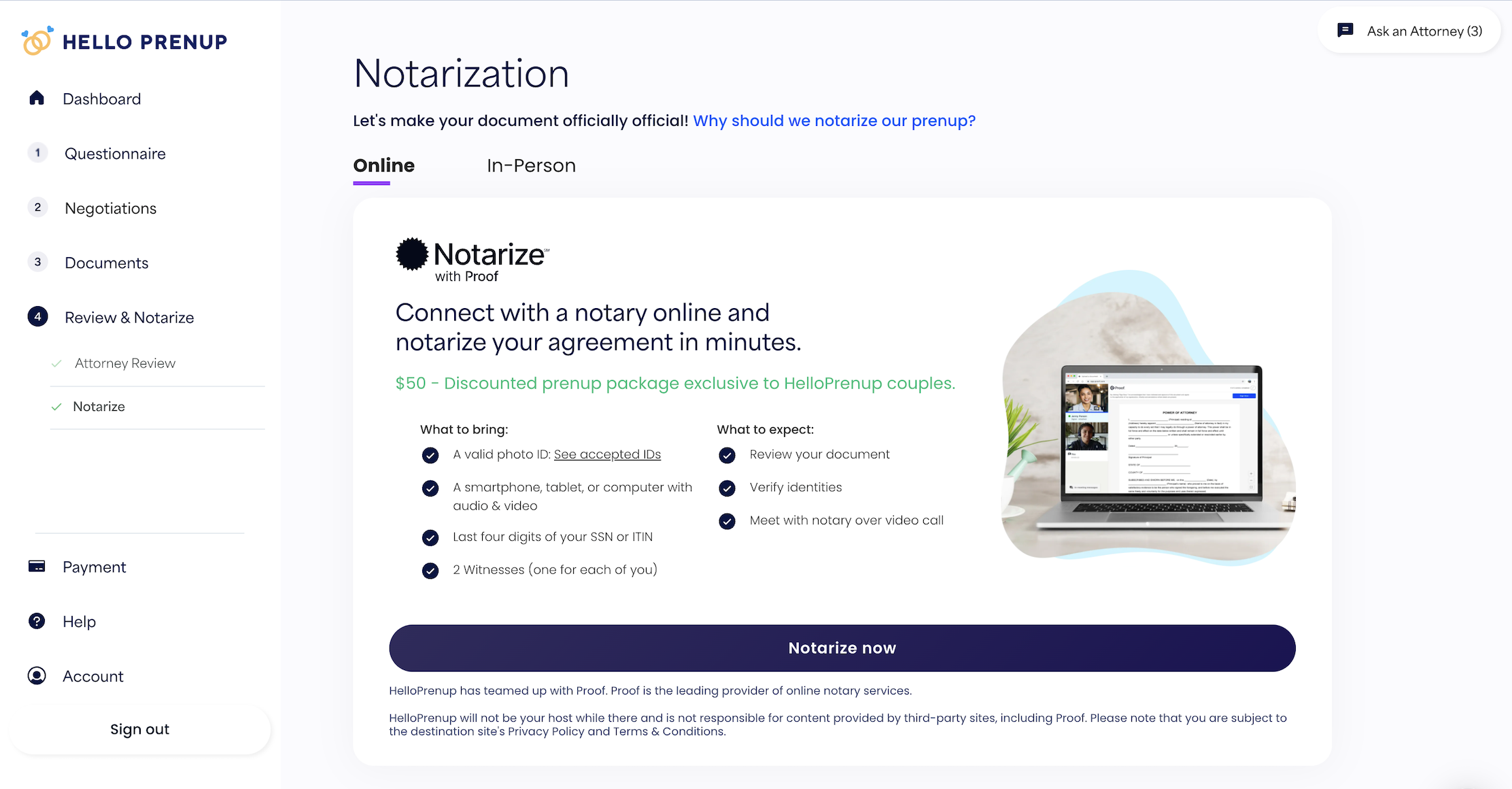
- Finalize your prenup with HelloPrenup
- Connect with Proof (formerly Notarize.com)
- Virtually connect with an online prenup notary
- E-Sign your prenup with notary
- Download & save your notarized document
- Store your notarized prenup securely within your HelloPrenup account
North Carolina Prenup Articles
When Adultery Voids the Prenup: North Carolina Court Enforces Strict Language in Stoeckel v. Stoecke
In a recent family-law decision from North Carolina, the state’s courts underscored a lesson that...

Do I Need a Lawyer for a Valid Prenup in North Carolina?
You’re getting married in North Carolina! Whether you’re planning a ceremony in the Blue Ridge...

Are Prenuptial Agreements Enforceable in North Carolina?
Planning a wedding in North Carolina? Congratulations! Before saying, “I do,” don’t forget to add...

7 Things To Know About Prenups in North Carolina
Tying the knot in North Carolina soon? Congratulations! It’s an exciting time in your life with...

Why ChatGPT 5 Will Never Compete With HelloPrenup
Have you heard ChatGPT 5 is going to be released next year? Are you wondering if it's about to...

What A Judge Thinks About HelloPrenup
As a retired California Superior Court Judge with over 30 years of experience in Family Law, I...
The information on this page was last updated in April, 2025. Hello Prenup provides a platform for self-help. The information provided by Hello Prenup along with the content on our website related to legal matters (“Legal Information”) is provided for your private use and does not constitute legal advice. We do not review any information you provide us for legal accuracy or sufficiency, draw legal conclusions, provide opinions about your selection of forms, or apply the law to the facts of your situation. If you need legal advice for a specific problem, you should consult with a licensed attorney. Neither Hello Prenup nor any information provided by Hello Prenup is a substitute for legal advice from a qualified attorney licensed to practice in an appropriate jurisdiction.
Ready to start your North Carolina prenup?
Sign-up. Complete prenup. Get married.