Looking for an Oklahoma prenup? Here’s what you need to know for an enforceable agreement and how to get started.

Oklahoma prenup basics
Prenuptial agreements (or “antenuptial agreements” as they’re called in OK), are contracts signed between a couple who are about to get married. It covers topics about property ownership, income, debt allocation, alimony, taxes, pets, rings, and so much more. While Oklahoma has a statute mandating that prenuptial agreements be in writing and signed, the specifics of their enforceability and validity are primarily shaped by legal precedents established through court rulings. This means that Oklahoma courts have played a crucial role in defining the requirements for a prenuptial agreement to be considered binding and enforceable, relying on their interpretations of legal principles from past cases. Things a court looks for in enforcing a prenuptial agreement are fairness, financial disclosure, and voluntariness (among other things). Let’s dive into the deets!
How to create a valid and enforceable Oklahoma prenuptial agreement
Oklahoma’s prenup statute (Okla. Stat. tit. 43 § 204) doesn’t provide much direction on what goes into a valid and enforceable agreement, instead it just confirms that prenups between couples are acceptable. Instead, Oklahoma case law tells us everything we need to know about enforcing a prenup.
Here are some things to consider when creating an Oklahoma prenup:
- Formalities: The prenup must be in writing and signed by both parties.
- No Fraud: The prenup must not be entered into under elements of fraud or misrepresentation (albeit, this is rare and exceedingly hard to prove in Oklahoma, according to the OK Supreme Court Griffin v. Griffin, 94 P.3d 96, 100 (2004).
- Voluntariness: The agreement must be entered into freely and voluntarily, with some understanding of their rights and what they were signing. (Matter of Burgess’ Estate, 646 P.2d 623 (1982)).
- Financial Disclosure: There must be a full, fair, and frank disclosure of finances from both parties.
- Fair Provisions: Courts will look at whether or not the party opposing the prenup had a fair provision for them in the agreement.
- Oklahoma’s “Burgess” Test: Here is a breakdown of the analysis done via the “Burgess Test,” which is one way an Oklahoma court evaluates the enforceability of a prenup, depending on the case:
- Is there a fair and reasonable provision made for the party opposing the contract? (For example, does the prenup provide something reasonable to the person who wants the agreement thrown out?).
- If not, was a full, fair and frank disclosure of the other spouse’s worth made before the execution of the contract?
- If neither of the above, did the party opposing the contract in fact, have a generally accurate knowledge of the other’s worth?
As you can see, an Oklahoma court looks at the overall fairness of the agreement, including voluntariness, fair financial disclosure, and fairness of the terms.

Do I need a lawyer for my Oklahoma prenup?
While having a lawyer to represent you or advise you on your OK prenup is not technically required, it will be considered as a factor in determining whether you entered the agreement voluntarily with an understanding of the agreement and its terms. For example, in the Supreme Court of Oklahoma case in Griffin v. Griffin, 94 P.3d 96 (2004), the court made sure to note that the wife (who was opposing the prenup) had legal representation, which was one of the factors that lead the court to determine the agreement was fair and entered into voluntarily. The court also noted that she had a business background, so she was privy to certain terms, and there were also fair provisions made for her.
Bottom line? Having a prenup lawyer may be a wise move, especially if your prenup is ever challenged one day, as it may be a factor the court takes into consideration to determine enforceability.
Join the thousands of couples creating their Oklahoma prenup today.
Create your free account now.
Default laws on property division in Oklahoma
In Oklahoma, without a prenup, a judge will divide a divorcing couple’s property “equitably” (not always 50/50). Judges in Oklahoma have broad discretion to determine what property division is just and equitable given the situation. Judges typically only divide what is considered marital property (property acquired during the marriage). On the other hand, what is categorized as “Separate Property” does not usually get divided in a divorce–and these are typically assets owned prior to the marriage.


Default laws on alimony in Oklahoma
Without a prenuptial agreement stating otherwise, a judge in Oklahoma has broad discretion in determining if alimony is appropriate and how much. (Alimony is the financial support from one ex-spouse to the other during or after a divorce). In Oklahoma, the factors a judge may consider when determining alimony include:
- The demonstrated need during the post-matrimonial economic readjustment period;
- The parties’ station in life;
- The length of the marriage and the ages of the parties;
- The earning capacity of each spouse;
- The parties’ physical condition and financial means;
- The mode of living to which each spouse has become accustomed during the marriage; and
- Evidence of a spouse’s own income-producing capacity and the time necessary to make the transition for self-support.
With a prenup, you can waive or modify alimony, so it’s not left up to a judge in the event of divorce. This provides certainty and financial protection for both parties.
How to end a marriage in Oklahoma
In Oklahoma, to end a marriage, you’ll need to have lived in the state for six months before you file for divorce there. Okla. Stat. tit. 43 § 102. In addition, in Oklahoma, you can file for divorce under the grounds of “incompatibility,” which simply means no one is at fault, or you can file it for a “fault” reason, which may be for adultery, extreme cruelty, impotency, and others. (Okla. Stat. tit. 43 § 101). The vast majority of cases for divorce are filed under incompatibility (a.k.a., “no-fault”) because it’s much simpler and cheaper that way. Filing a divorce under some type of fault grounds, such as divorce, tends to be lengthier and more expensive.

Important prenup case law in Oklahoma
Remember, case law in OK is super important because it tells us what we need to know about the enforceability of prenups. Case law is court decisions that explain certain areas of law, like prenups. Let’s dive into what Oklahoma judges are saying about prenups.
How detailed does financial disclosure need to be in Oklahoma?
We know that financial disclosure is super important to enforcing an Oklahoma prenup, but what exactly is required for financial disclosure to be considered sufficient? The Supreme Court of Oklahoma dealt with this issue in 2004. Here’s what happened:
A husband and wife got married and signed a prenup before getting married (with the help of lawyers). The husband had a significant amount of trust assets, and the wife was a college-educated businesswoman. The prenup kept everything separate but provided the wife with a lump sum payment depending on the length of the marriage. She would get $250k if the divorce occurred between 5-10 years of marriage and $500k if the marriage lasted longer.
During the divorce, the wife argued the prenup wasn’t enforceable for several reasons, one of them being that there was misrepresentation due to a lack of sufficient financial disclosure. She argued that his $7 million trust fund was not listed; however, he had actually listed the trust but in the amount of $25 million. Because this was actually an overestimate, the court said it was not considered misrepresentation.
The court also applied the Burgess test to determine if the agreement was enforceable. Basically, that test asks if:
(1) there was a fair provision for the wife,
(2) if not, was there was full, fair, and frank financial disclosure, and
(3) if neither of the first two, did the wife at least have adequate knowledge of the assets?
The court said “yes” to all three. She was provided with a lump sum provision, which the court deemed fair. Plus, he provided full, fair, and frank financial disclosure.
Is a prenup unfair and unenforceable if one party has more money than the other?
A couple in their 50s decided to tie the knot (the husband on his third marriage and the wife on her second). Both had adult children from previous marriages. They decided to sign a prenup which stated that neither party may have the right to the other’s property in divorce or death.
Eventually, after the husband’s death, the wife sought to get the prenup thrown out so she could receive a portion of his estate.
The court upheld the prenuptial agreement between Mr. and Mrs. Burgess, despite its lack of specific “fair” provisions for her and the disparity in their wealth (he had more than her). The court explained:
– Voluntarily Entered: The agreement was freely entered into by both parties, who were adults with prior marriages and some level of financial independence. Mrs. Burgess had a generally accurate understanding of Mr. Burgess’s wealth, even if full disclosure wasn’t provided.
– Absence of Fraud or Coercion: There was no evidence of fraud, duress, coercion, or overreaching in the creation of the agreement.
– Policy Considerations: The court emphasized the importance of upholding prenuptial agreements between competent adults, especially when there is no evidence of unfairness or deception.
The takeaway? Just because you signed an agreement with someone wealthier than you doesn’t mean you can later claim the agreement isn’t fair and get out of it. In addition, the court will analyze your situation based on several factors.
Even with no fair provisions for one of the spouses, the prenup may still be upheld
In this case, the Oklahoma court upheld a prenup even though it specifically found that there was no fair provision for the wife. The prenup made sure each party kept their assets separate. However, the Husband’s property nearly doubled in value, while the wife had very little. The wife sought to throw out the agreement based on duress and lack of proper financial disclosure.
The court still upheld the prenuptial agreement as valid (even though it noted there was no fair provisions for the wife), due to the following reasons:
– Wife’s awareness of Husband’s assets: She had a general understanding of the husband’s financial situation before the marriage.
– No Duress: While the wife claimed she signed the agreement under duress, the evidence showed she had ample time to review it (3 months) and signed it voluntarily.
– Prior Marriages and Understanding: Both parties had been previously married, and the wife was aware of the husband’s concerns about going through another bitter divorce.
Remember, the Oklahoma court utilizes the “Burgess” test which asks first if there was a fair provision for the person wanting the prenup to be thrown out. If not, was their full, fair, and frank financial disclosure? If not, did they at least have adequate knowledge? Here, she did have adequate knowledge, so the test was satisfied and prenup enforced.
Oklahoma Prenup Articles

Why ChatGPT 5 Will Never Compete With HelloPrenup
Have you heard ChatGPT 5 is going to be released next year? Are you wondering if it's about to...

What A Judge Thinks About HelloPrenup
As a retired California Superior Court Judge with over 30 years of experience in Family Law, I...

Common Prenup Clauses: What’s Typically Included?
A prenuptial agreement (or, as the kids say, a prenup) is a contract outlining how a couple's...

DIY Prenups: Risks and Considerations
Congrats on the engagement! If you’re here, it’s likely that marriage is on the horizon. This...
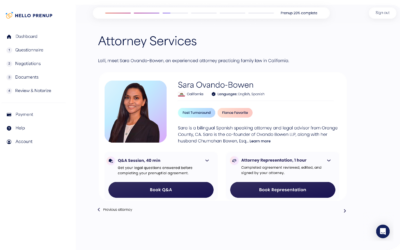
Is Attorney Representation right for me?
HelloPrenup’s self-serve platform was developed by seasoned family law attorneys and agreements...

Is a Q&A right for me?
HelloPrenup was conceived, written, and is constantly optimized by attorneys across the U.S. The...
The information on this page was last updated in July, 2024. Hello Prenup provides a platform for self-help. The information provided by Hello Prenup along with the content on our website related to legal matters (“Legal Information”) is provided for your private use and does not constitute legal advice. We do not review any information you provide us for legal accuracy or sufficiency, draw legal conclusions, provide opinions about your selection of forms, or apply the law to the facts of your situation. If you need legal advice for a specific problem, you should consult with a licensed attorney. Neither Hello Prenup nor any information provided by Hello Prenup is a substitute for legal advice from a qualified attorney licensed to practice in an appropriate jurisdiction.
Ready to start your Oklahoma prenup?
Sign-up. Complete prenup. Get married.