Looking for a Pennsylvania prenuptial agreement? Here’s what you need to know for an enforceable agreement and how to get started.

What is a prenup?
A prenuptial agreement (or a “premarital agreement”) is a contract between two soon-to-be spouses that outlines certain financial rights and obligations, such as ownership of property, spousal support, rights in estates upon death, inheritances, pets, and more. Prenuptial agreements must be signed before walking down the aisle and are only effective if and when the marriage takes place.
Prenuptial agreement legal requirements in Pennsylvania
So, how do you make a prenuptial agreement in Pennsylvania? Let’s talk about what is required to make a valid and enforceable agreement in the state.
Here’s what you need to know:
-
- The agreement must be in writing
- The agreement must be signed by both parties
- There must be adequate financial disclosure of all income, assets, debts, and future known inheritances
- The agreement must be entered into voluntarily without any fraud, duress, or coercion
Overall, the focus of a court when assessing an Alaskan prenup is that the agreement is “legally procured and ostensibly fair”
Benefits of having a prenup
A prenuptial agreement has many benefits—it’s not just about protecting the wealthy spouse. It can also protect children, promote marital health, and so much more.
As you can see, there are so many reasons prenups are a good idea—from protecting individual interests to promoting marital harmony.
Here are some ways a prenup can benefit you:
- It can determine how certain assets are managed during the marriage
- It can require spouses to align on certain topics prior to the marriage
- It can protect the lower-earning spouse to ensure they are protected in the event of a divorce, such as a stay-at-home parent
- It can (sometimes) protect reproductive property (depending on your state)
- It can protect children from a previous marriage by ensuring assets stay with them in death or a divorce
- It can create financial security and protect individual interests
- It can facilitate tough conversations between future spouses that may not have otherwise happened, such as conversations about money management
- It requires transparency through financial disclosure, which can improve the relationship trust
- It can prevent a contentious divorce process
What can you include in a Pennsylvania prenup?
Now, let’s talk about what you can put into your Pennsylvania prenuptial agreement. There are plenty of options as long as you steer clear of child custody, child support, and any other matters against public policy. Here are some clauses included in Pennsylvania prenups:
- Property ownership and management
- Property division in a divorce
- Elective share waivers upon death (whether a spouse may inherit from the other’s estate)
- Ownership of gifts/inheritances from third parties
- Business interests
- Pet ownership
- And more
People often use prenups to protect assets they’re bringing into the marriage, clarify financial responsibilities during the marriage, or safeguard family inheritances or businesses. In Pennsylvania, as long as both parties agree and the terms don’t violate public policy, your prenup can be highly customized.

Do you need a lawyer for a valid prenup in Pennsylvania?
No! According to the landmark case in Simeone, there is no legal requirement to hire a lawyer for a prenuptial agreement in Pennsylvania. The Simeone Court explained that requiring a lawyer for a prenup would be a “paternalistic” and overly burdensome requirement to impose on the public, making prenups harder to get. The result? No lawyers necessary for a Pennsylvania prenup. However, hiring a lawyer for a prenup can have benefits, such as creating a custom agreement, ensuring it’s state-compliant, and answering your legal questions.
What is spousal support, and can you waive it in a prenup?
Spousal support is the financial support from one ex-spouse to the other in the event of a divorce. It can be an incredibly useful tool for some to ensure they are able to survive financially without their spouse in case of a divorce. On the other hand, it can also be an incredibly burdensome requirement for the folks who have to pay it. With a prenuptial agreement, you may waive or modify spousal support rights in Pennsylvania, which allows couples to negotiate and agree to the rights and obligations they have when entering into a marriage.

Join the thousands of couples creating their Pennsylvania prenup today.
Create your free account now.
PA caselaw
Case law is the term used by lawyers to describe court opinions that help shape the law in certain areas. Prenuptial agreement case law in Pennsylvania can help us understand how prenups are enforced in the state. Let’s dive in.
The landmark case on prenuptial agreements in Pennsylvania (no lawyers necessary)
In Simeone v. Simeone (1990), the Pennsylvania Supreme Court upheld the enforceability of a prenuptial agreement signed the day before the wedding, even though the wife did not have a lawyer. The court ruled that prenuptial agreements are contracts and should be evaluated using traditional contract principles. As long as the agreement is not obtained through fraud, misrepresentation, or duress—and there has been full and fair financial disclosure—it will generally be upheld. The court emphasized that parties are bound by what they sign, even if they don’t fully understand every term or get a “good deal.” This enforces the idea of the freedom of contract and that prenups in Pennsylvania are enforceable even if only one party had an attorney—so long as the agreement was voluntary and financially transparent.
Asset misrepresentation in financial disclosure
In Porreco v. Porreco (2003), the Pennsylvania Supreme Court ruled that a prenuptial agreement was valid and could not be thrown out just because the wife claimed her husband lied about how much her engagement ring was worth . The Court said that even if the husband did exaggerate the value ($21,000 when it wasn’t even a real diamond), the wife had the ring in her possession and could have gotten it appraised before signing the agreement. Because she didn’t, the Court found that her trust in his statement wasn’t “reasonable” enough to cancel the prenup. The big takeaway? If you’re entering into a prenup, it’s up to you to check the facts—especially when it comes to your own property.
Get your prenup notarized online with our exclusive partnership with Proof (formerly Notarize.com)
Include PA notarization with your prenup for just $50:
Now you can create your prenuptial agreement, collaborate on terms with your partner & optional attorneys, then notarize your prenup—all from your couch. The only thing we can’t do? Get married for you.
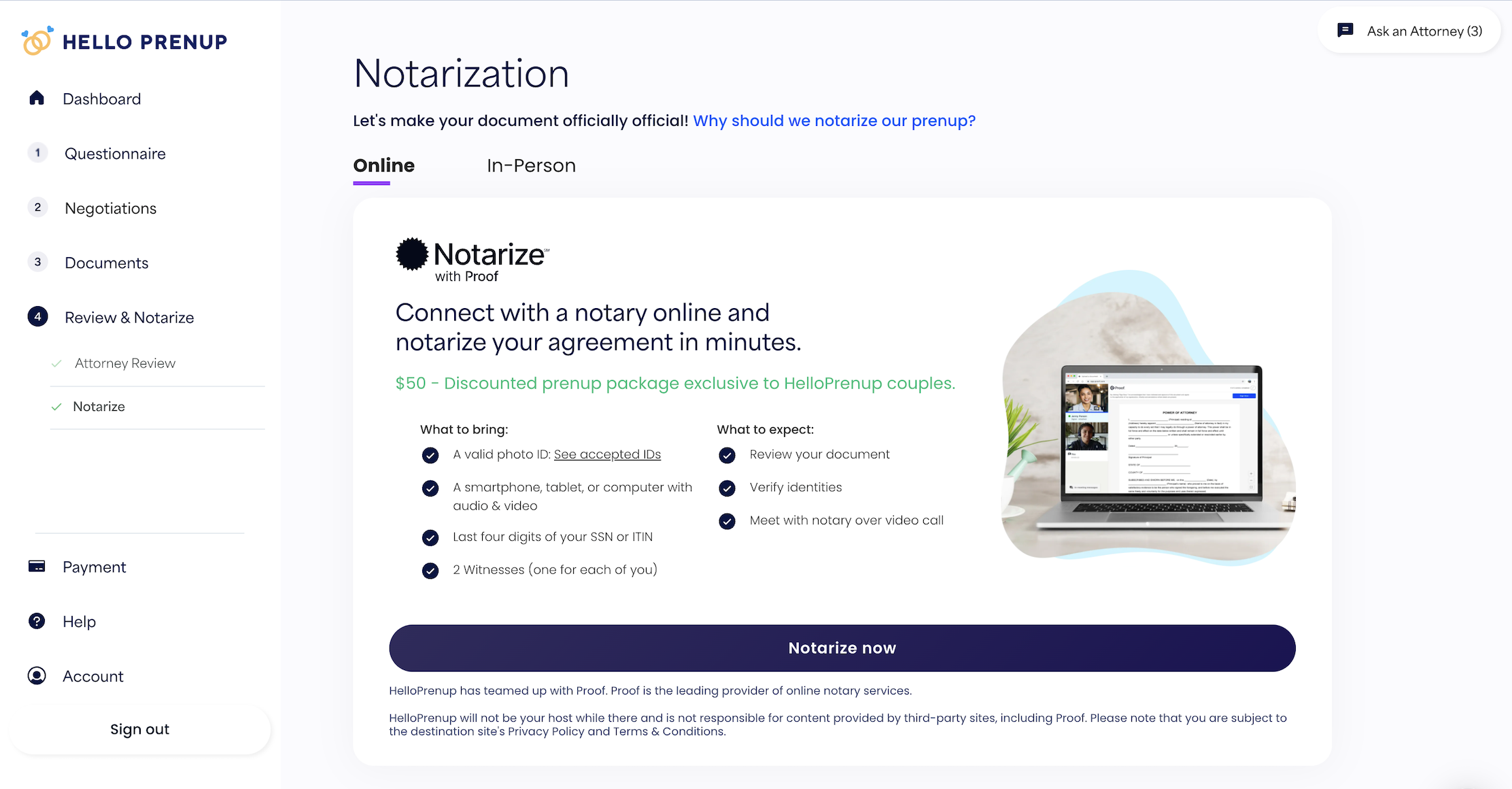
If you purchase Attorney Representation with your prenup, Notarization is included.
- Finalize your prenup with HelloPrenup
- Connect with Proof (formerly Notarize.com)
- Virtually connect with an online prenup notary
- E-Sign your prenup with notary
- Download & save your notarized document
- Store your notarized prenup securely within your HelloPrenup account
Pennsylvania Prenup Articles

Breaking Down Prenup Pricing in Pennsylvania
Starting a life together in Pennsylvania, whether in Philadelphia’s row-house neighborhoods,...

Do you need a lawyer for a valid prenuptial agreement in Pennsylvania?
Walking down the aisle soon and considering a prenup? Congrats—on both the engagement and the...

Prenuptial Agreement Attorney in Pennsylvania
Prenuptial Agreement Attorney in PennsylvaniaBefore you dive headfirst into the world of marriage,...

Pennsylvania Prenup & Divorce Statutes
So, you’re getting hitched in the historic Commonwealth of Pennsylvania? Let’s get to work on your...
The information on this page was last updated in May, 2025. HelloPrenup provides a platform for self-help. The information provided by Hello Prenup along with the content on our website related to legal matters (“Legal Information”) is provided for your private use and does not constitute legal advice. We do not review any information you provide us for legal accuracy or sufficiency, draw legal conclusions, provide opinions about your selection of forms, or apply the law to the facts of your situation. If you need legal advice for a specific problem, you should consult with a licensed attorney. Neither Hello Prenup nor any information provided by Hello Prenup is a substitute for legal advice from a qualified attorney licensed to practice in an appropriate jurisdiction.
Ready to start your Pennsylvania prenup?
Sign-up. Complete prenup. Get married.