
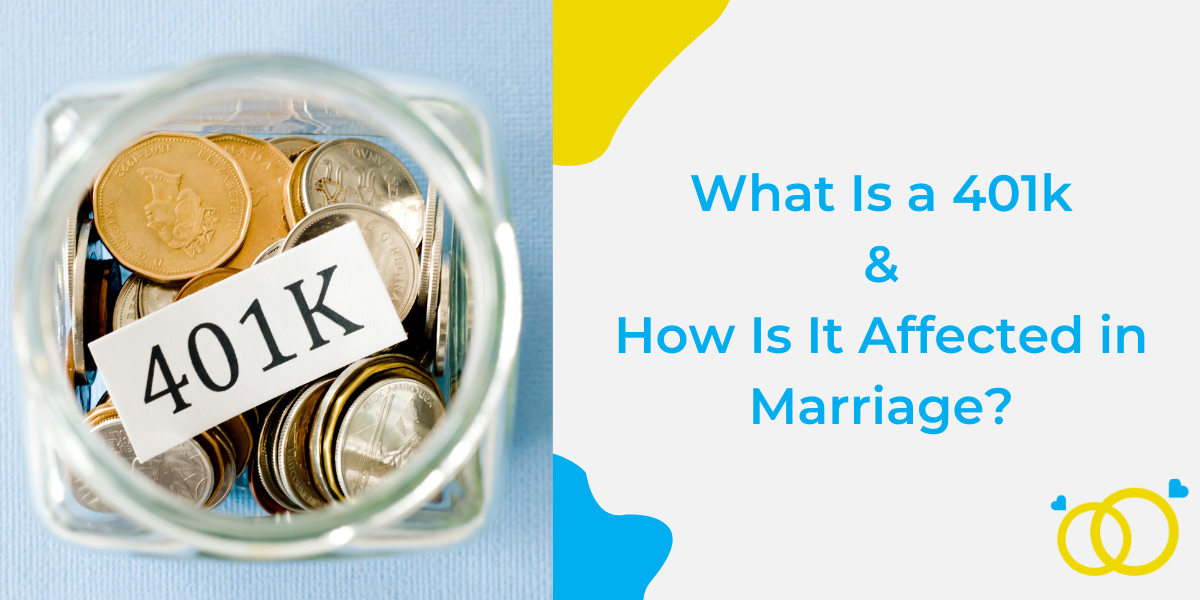
Did you know that just about 35% of Americans ages 15 to 64 have a 401(k)-style account as of 2020? This makes the 401(k) the most common type of retirement account
Quick pop quiz. Are you:
- a) engaged to be married?
- b) interested in investing but don’t know much about it yet?
- c) starting a new job that offers a 401(k)? Or
- d) any combination of the above?
If you answered yes to any of the above options, then this article is for you. Below, we’ll explore the ins and outs of what exactly a 401k is, what might be the benefits of having one, what happens to it when you get married, and how you can protect those hard-earned retirement savings in case of divorce.
What is a 401(k)? (Imagine a jar of money that grows tax-free!)
A 401k is a retirement account usually offered by an employer. Employees can make contributions to this account, and some employers match their contributions. Here’s some more on what a 401(k) is and why they’re awesome:
- Employer-sponsored plan: Some employers offer 401(k) benefits and help you set up your 401(k). Unfortunately, about 56% of Americans do NOT have access to this option, so if you are one of the lucky ones, good for you!
- Grow your nest egg: You put in some money from each paycheck, and your employer might match it (“free” money!). This money then grows and grows and grows over the years until you retire, thanks to compound interest.
- Taxes: There are “flavors” of 401(k)s that differ based on how taxes are handled:
- Traditional: Pay less taxes now, owe them when you withdraw in retirement.
- Roth: Pay taxes upfront, then your money grows tax-free for life!
- The waiting game: Generally, touching the money before you actually retire can lead to financial penalties. But if you let it sit, it compounds like magic over time.
- Self-employed? No worries!: Solo 401(k)s are a thing – ask a financial advisor on how to set this up.
Why it’s awesome:
- Easy saving: Automatic paycheck deductions mean you don’t even miss the money.
- Potential for big returns: Over many years, even small contributions can add up to a LOT.
- Tax benefits: Either lower your tax bill now or let your money grow tax-free.
Will my 401(k) be split in a divorce? Here is how marriage affects it.
What happens to your 401(k) when you get married? Well, that depends on the state laws that apply and whether or not you have a prenup. Let’s explore more:
- The general rule: Without a prenup, most states say that assets acquired during the marriage are considered joint property, divisible in divorce (not always the case, though). This includes 401(k) contributions and appreciation. Contributions and appreciation accrued prior to the wedding day may be considered separate property, not divisible in divorce (again, very much depends on your state laws and your situation).
- But… it’s only in my name!: Even if it’s just your name on the account, a court could still divide your 401(k) as ‘marital’ contributions. Laws vary by state, though.
- Protect yourself in advance:
- Prenup: A prenup is a practical tool to protect your 401(k) during marriage and potential divorce. It can outline how your 401(k) will be handled in any scenario.
- Delay big withdrawals: If your spouse seems likely to drain the account pre-divorce, you might be able to get a court order to freeze it temporarily.
Bottom line: 401(k)s are useful tools to amass wealth, achieve financial freedom, and eventually retire one day. However, when you get married, you are potentially putting your 401(k) at risk of being split in a divorce. State laws vary, but a prenup is always a good thing to consider to ensure your assets stay with you.
How to protect your 401(k) if a divorce happens
Let’s face the facts: divorce happens. But it doesn’t have to drain your 401(k) (and, yes, it can happen in a divorce). One important step you can take towards protecting your retirement savings is to get a prenuptial agreement prior to getting married.
- Understand what’s at risk: Money you put into the 401(k) during marriage is usually considered shared property, even if it’s only in your name. Of course, state laws vary, but this is the general rule in many states.
- Start with a prenup: It’s the most reliable way to set rules on how your retirement assets will be divided should you ever split up. Don’t be afraid of the conversation–it shows you BOTH care about your financial futures.
- Keep the 401(k) separate: Ensure you delineate in your prenup that your retirement accounts, including your 401(k), are kept as your separate property.
- Negotiation matters: If your partner isn’t willing to waive their right to your potential 401(k), there are other ways to offset this loss for them. For example, a wealth equalization clause is a one-time, lump-sum payment in lieu of sharing your 401(k). This could be a better trade-off as it provides for certainty in the amount that will be owed compared to potentially splitting an undetermined 401(k) future value.
The takeaway? A strong prenup is the most proactive way to protect your hard-earned retirement savings.
What is a QDRO? (Hint: It’s how you transfer money from a 401k in a divorce)
A Qualified Domestic Relations Order (QDRO) is a court-approved legal document that says how to split retirement accounts like 401(k)s. The “QDRO” directs the 401k administrator on how to distribute a payment from the 401k to the non-employee spouse.
In plain English, the QDRO basically says that the ex-spouse is able to receive a payment out of the 401k even though they aren’t the person named on the account.
Example: William and Jane are getting divorced. Jane has a 401k with $300,000 in it at the time of divorce. All $300k was earned during the marriage. A court orders that 50% of this 401k must go to William. William’s attorney drafts and submits the QDRO to Jane’s 401k plan administrator. The QDRO states that $150,000 of the 401k should go to William and that he must deposit it into his own retirement account.
How HelloPrenup can help you and your 401(k)
HelloPrenup offers clauses that address 401(k)s and other investment and retirement accounts. You can ensure that your prenup includes provisions stating who gets the 401(k) in the event of a divorce. You can also use the prenup to supplement any estate planning documents you have to further ensure your 401(k) is treated how you want it to be in the event of death, as well.
The moral of this story is threefold:
1.) If you don’t already have a retirement savings account, try to get one. They are an effective financial tool to set yourself up for retirement.
2.) It’s important to be aware of how marriage may affect your 401k.
3.) Co-create your future & protect your ass(ets) by getting a prenup today!
Frequently Asked Questions (FAQs) about prenups and 401ks
There are tons of questions on this topic from our readers, so we answered a few of the most common below:
Q: How long do you have to be married to get part of a 401k?
A: There’s no exact number here; the answer will also depend on your state. Each state has its own divorce property division laws. However, generally, in community property states, you can expect to split the contributions and interest made during the marriage from the 401k 50/50. In equitable distribution states, the answer isn’t so straightforward–it will depend on your unique circumstances and the discretion of a judge.
Q: How do I protect my 401k in a divorce?
A: A prenup, of course! Outside of a prenup, there’s no real good way to protect your 401k–the state default divorce laws will apply and your 401k may be subject to division.
Q: What is a QDRO?
A: It’s a legal document that can order payment from one ex-spouse’s 401k to the other’s retirement account in a divorce.

Julia Rodgers is HelloPrenup’s CEO and Founder. She is a Massachusetts family law attorney and true believer in the value of prenuptial agreements. HelloPrenup was created with the goal of automating the prenup process, making it more collaborative, time efficient and cost effective. Julia believes that a healthy marriage is one in which couples can openly communicate about finances and life goals. You can read more about us here Questions? Reach out to Julia directly at Hello@Helloprenup.com.
0 Comments