
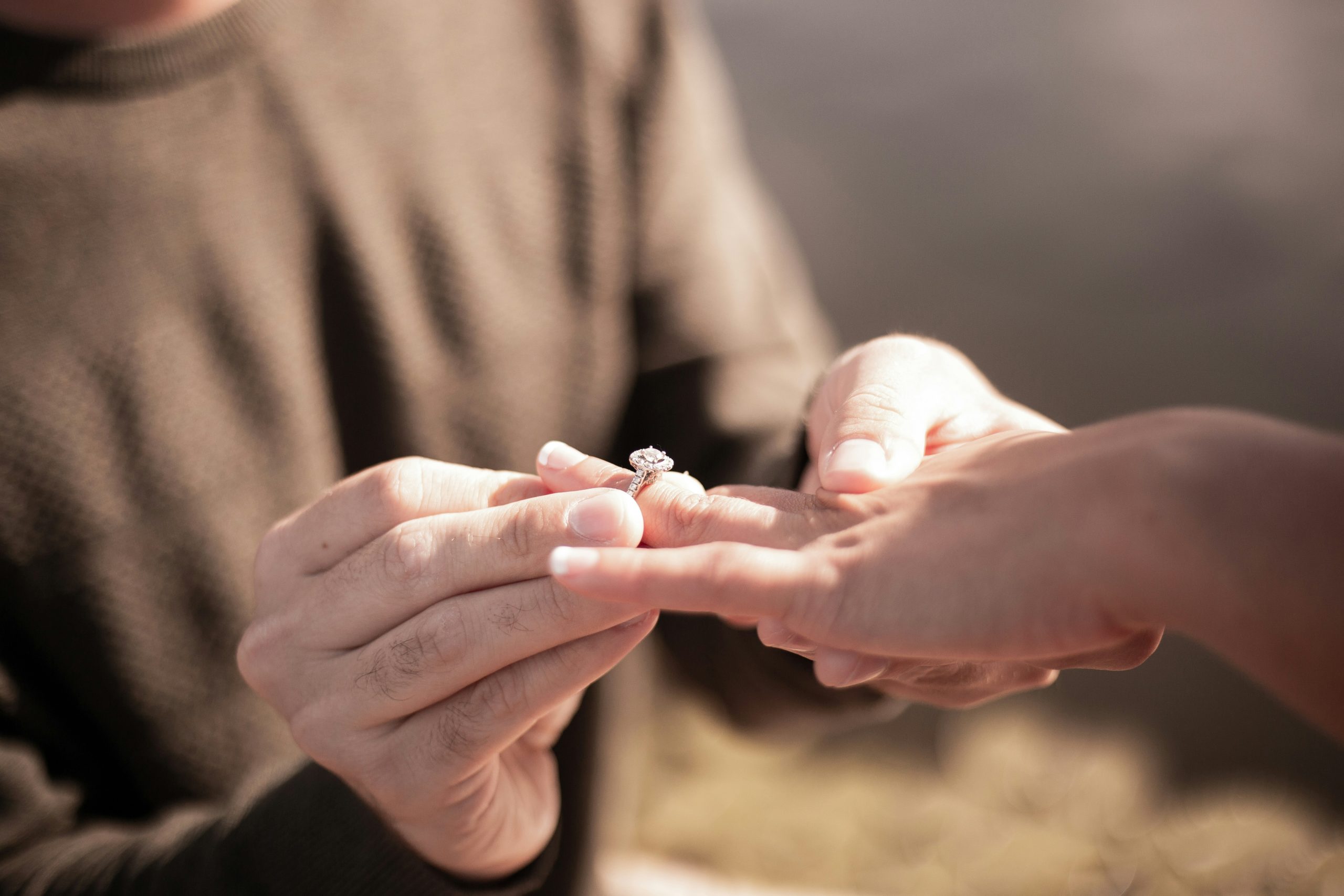
You’ve picked the ring. You’ve scouted the perfect spot, built out a playlist, and even coordinated with a photographer hiding behind a tree. And somehow, you’re still lying wide awake the night before, questions running through your head, half convinced you’ve forgotten something or that something isn’t kosher.
If you’re nodding along right now, you’re in good company. The overthinking and second-guessing aren’t a sign you’re making the wrong choice. They’re a sign you really care and want this to be an amazing experience for your future life partner. It also doesn’t help that this isn’t exactly the kind of thing people talk through over a beer at the local pub or a casual dinner with friends. Proposal etiquette, the knee, the ring hand, the timing, who’s supposed to ask whom, has been quietly passed down through movies and family stories for so long that it feels like there’s a “correct” way to do it, and a wrong way that might somehow tank the whole thing.
Here’s the good news: there are general rules and etiquette that can help you avoid any faux pas, and since this comes from a therapist’s lens, we’ll go over them with a healthy dose of exploration into what might be happening for you emotionally along the way. So, we’ll cover the traditional answer, where it actually comes from, what relationship research says about sticking to (or straying from) the script, and the etiquette that matters far more than which leg happens to be bent.
Does which knee really matter?
If you want the textbook version, the tradition is the left knee: down on the left, right foot planted, ring held out in your right hand. That’s the version that’s been passed down through the decades. But there’s no hard-and-fast rule, and no research showing that proposing on a different knee, or skipping the kneel altogether, changes how a proposal lands.
Sure, some etiquette guides claim the right knee is reserved for other ceremonial gestures, like knighting someone or specific religious kneeling customs, but that doesn’t mean it’s off-limits for a proposal too. If you have a bad knee, a disability, limited mobility, or you’re proposing somewhere kneeling isn’t practical, sit, stand, or crouch instead. Nobody has ever said no to a proposal because the wrong leg hit the floor.
Where does the one-knee tradition originate from?
There’s no hard-and-fast rule about which knee, but the kneeling itself didn’t come out of nowhere. It goes back to medieval Europe, where knights would kneel before their lords, and, separately, before the women they were courting, as part of the whole code of chivalry. Kneeling shows up in religious practice too, as a way of getting low to show humility toward something bigger than yourself (aka God). Somewhere along the way, those two threads, courtly love and reverence, got intertwined together into the version we know today: one person lowers themselves, essentially handing the other person the power to decide what happens next.
It’s worth noticing that this is what historians sometimes call an “invented tradition,” a custom that feels ancient but was actually assembled and popularized far more recently than people assume, then repeated until it hardened into “the way it’s done.” That doesn’t make it meaningless. It just means it’s worth understanding where a tradition comes from before deciding whether it’s one that fits your values and how you want to approach this moment.
Why do small details feel bigger during a proposal?
Outside of the etiquette lens, details like which knee to get down on hit differently because of the huge emotional stakes and the sheer unpredictability. No matter how “sure” you are, every minute that brings you closer to the moment reminds you just how much you can’t control.
So what happens when you realize how much is actually out of your hands? You do what most people do: grab onto whatever you can control and lean on small rituals to manage the anxiety of the bigger unknown. We see this in anxiety all the time. Humans reach for a structured, repeatable set of actions because it restores a felt sense of control, even when the ritual itself has absolutely no logical connection to the outcome. That’s why the fixation lands on the knee, the exact wording, the ring angle, the playlist. It’s not shallow perfectionism. It’s your nervous system trying to create certainty in a moment that fundamentally can’t offer any.
Will proposal etiquette change anything?
Here’s some trivia to put in your back pocket: there is a connection between how a proposal is done and the success rate.
Here’s the part that might surprise you. A large content analysis dug through hundreds of real proposal stories, the kind people post online, and compared the ones that got a “yes” to the ones that got a “no.” Turns out sticking to the traditional script (kneeling, presenting a ring) actually tracked with getting accepted. Skip the kneel, and the odds of rejection jumped by about 4.7 times. Skip the ring entirely, and they jumped by about 8.5 times.
Now, this is a correlation not causation. Kneeling itself does not mean or cause another person to say “yes” to a proposal on its own. It’s really just a signal that someone who is kneeling is often a person who has put a lot of thought, time, effort… that they really want this person to say yes!
Skipping the ring or the knee usually isn’t “the problem” itself. It’s often a symptom of something else: timing that’s off, an unconscious signal you haven’t listened to yet, or a proposal driven by crisis rather than readiness. In fact, the same research found that timing mismatches were the single strongest predictor of a rejected proposal.

What’s driving the desire to follow the etiquette is what actually matters
If you’re determined to get the “rules” right, take a minute to ask why. Is it because you’re worried about how your partner will respond? Does your partner have strong feelings or expectations you’re trying to meet? Or do you have your own strong ideas about what a proposal should look like?
Getting clear on where that pull, or that anxiety, is coming from can help you figure out whether it (aka proposal etiquette) is actually worth your energy. For a lot of people, it genuinely comes down to wanting to feel chosen, celebrated, and secure in the moment. Treating that desire with respect matters far more than any leg placement ever will.
When it’s okay to break from tradition entirely
Maybe you’ve done some of that digging and realized the pull to follow a specific script isn’t actually wanted or needed. Good to know: plenty of couples skip the knee, the ring, or the whole surprise element, and their engagements are exactly as legitimate as anyone else’s.
Instead, focus on building an experience that feels emotionally meaningful for both of you. That might still include a ring, a heartfelt moment, a thoughtful location, or loved ones woven into the process, or it might not. That’s the healthier model, honestly, regardless of who’s proposing to whom. Keep the parts of the tradition that feel true to you. Skip the parts that feel like pure performance. And don’t confuse “different from the script” with “less serious.”
The etiquette that really counts: planning your future together
Pulling it all together, the left knee is the traditional answer to “which knee should you propose on”, but this isn’t a hard and fast rule; all things in place, no partner has said “no” because the wrong leg hit the floor. The kneeling itself has real history behind it, and the reason all of this feels so high stakes often comes down to psychology. Big emotional states plus the real experience that no one is certain, makes people grab onto whatever part of the experience they can control.
That’s not a flaw. It’s worth noticing, though, because the details themselves aren’t what really moves the needle. What actually helps is understanding why you’re drawn to a specific version of this moment, whether that’s tradition, your partner’s expectations, or your own vision, and letting that answer guide you rather than a rulebook. Some couples will want the ring, the knee, and the whole classic script. Others will build something that looks very different than what etiquette dictates. Both are equally legitimate and likely to end in a “yes” as long as the person on one knee (physically or metaphorically) has put in the thought.
Get the timing right and the why, and the knee will take care of itself.

Dr. Vivian Oberling is a licensed clinical psychologist with degrees from UCLA, Harvard, and Stanford. In her private telehealth practice, she works with adults navigating anxiety, identity shifts, and relationship dynamics—whether they’re dating, partnered, or parenting. She also provides executive coaching and behavioral health advisory support to tech startups and legal tools reshaping how we think about love, marriage, and psychological safety. Dr. Oberling combines 10+ years of clinical expertise with modern, real-world insight to help people move through uncertainty with clarity and connection.
0 Comments