

How does one actually go about enforcing their prenuptial agreement in Ontario, you ask? It’s very simple– follow Ontario’s laws for creating an enforceable agreement, incorporate the document into the divorce settlement, and continue on with other aspects of the divorce process. But what makes a prenup enforceable? And what are some examples of how a prenup may not be enforced? We dive into this and more below.
What makes a prenup enforceable in Ontario?
Let’s go over what makes a prenup “enforceable” (a.k.a., when a judge incorporates the terms of the prenup into the divorce settlement, requiring the parties to abide by the agreement). In Ontario, here’s what you need to do in order for a prenup to be enforced, according to the Family Law Act, Part IV, Sections 51-54:
- The prenup is in writing and signed by both parties
- The prenup is witnessed by a party unrelated to the contract
- Both parties share the accurate values of their assets, income, debt, and future inheritances with each other (financial disclosure)
- There is no fraud, duress, coercion, or other type of force in the creation of the agreement
- The agreement is reasonably fair and not overly one-sided (or unconscionable)
If all of the above are satisfied, you have very good odds of having an enforceable prenuptial agreement in Ontario.
How do you enforce your prenup once you’ve decided to get a divorce?
So, how do you actually go about enforcing your prenup in a divorce? Let’s use an example to demonstrate how this might work. John and Lisa have a prenup, and now they are filing for divorce. John and Lisa each speak with their respective divorce lawyers to discuss the next steps. John and Lisa both want the prenup to be enforced, so the lawyers complete a Form 13.1 Financial Statement listing their assets and debts on the date of separation. The difference is their Form 13.1 Financial Statement will include the exclusions or financial terms the couple agreed to in the prenup. The lawyers will incorporate the Financial Statement and the prenup terms into their separation agreement. The financial issues are already resolved. Then, all that’s left for John and Lisa to do is to work out child custody, child support, and visitation rights.
On the other hand, if John or Lisa had challenged the validity of the prenup, they would have either gone into negotiations with their respective lawyers and come up with a settlement, or they would have asked the court to determine the validity. Then, a judge would analyze the agreement under the existing provincial law (if applicable, federal law) and make a decision.
So, as you can see, enforcing your prenup is typically as simple as incorporating the terms into the final separation agreement. However, things get a little stickier when one spouse wants to challenge the validity of the agreement. However, challenging a prenuptial agreement is not very common because it is costly and time-consuming to do so. It costs you money to pay your lawyer to dispute the prenup. It is also very risky because if you challenge the prenup and you are not successful, you will be required to pay the other side’s legal fees. This can often exceed six figures. So people generally don’t want to spend the time and money to do that.
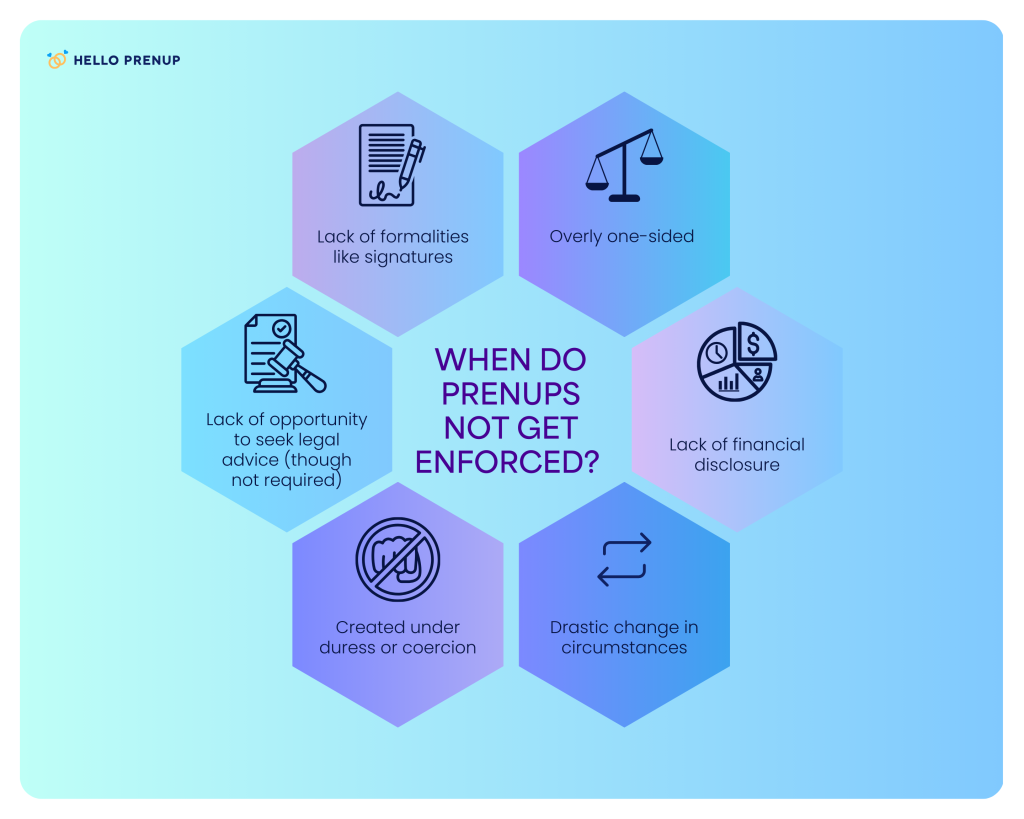
When do prenups not get enforced?
So, you may be wondering, what happens in those cases, like in the scenario above, when a person challenges the validity of the agreement, and the judge agrees? Under what circumstances would that occur? Here are some examples of when a judge may set aside a prenuptial agreement:
- The agreement is not executed properly (not in writing, not signed, not witnessed)
- The agreement doesn’t have proper financial disclosure (one party omitted financial information or under valued assets)
- The prenup was created under an aggressive amount of pressure from one spouse, rising to the level of coercion or duress
- The prenup is overly one-sided and leaves one person with a significantly unreasonable portion of the family property – this is a high threshold to meet. It must “shock” the conscious of the Court.
- One party did not have an opportunity for independent legal advice and the lack of advice caused them harm. Generally, you can’t decline legal advice and then raise it as a basis to overturn the agreement in the future.
- Circumstances have changed so drastically since the creation of the prenup that enforcing it would be unreasonable
- The agreement was signed too close to the wedding day and was signed under duress.
Child matters in prenups will not be enforced in Ontario
One thing to remember is that prenuptial agreements in Ontario cannot address parenting plans, decision making or, child support. This is an issue that is left to a judge at the time of divorce and must be approved based on the child’s best interests. Why? Because parents may not know what is best for their child at the time of the prenup and you cannot contract away other people’s rights (children have a right to child support).
This means that a prenup with parenting plan/support clauses will not be enforced in Ontario. It will likely be severed from the rest of the agreement and then addressed at the time of the divorce.
What can be enforced in a prenup in Ontario?
Don’t worry, though–there are tons of clauses you can include in your prenuptial agreement that can be enforced. Here are some of the clauses you can include in your Ontario prenup agreement:
- Property division
- Spousal support
- Inheritance between spouses upon death
- Inheritances from third parties
- Business ownership
- Lump sum payments from one spouse to another
- Gifts
- Engagement/wedding rings
- Confidentiality
- Life insurance
- Pet custody
- And more
While prenuptial agreements can address a variety of issues related to property and finances, it’s important to remember that they cannot dictate matters involving children, such as parenting plans or support.
The bottom line
So there you have it–everything you need to know about enforcing a prenuptial agreement in Ontario, Canada. It’s relatively straightforward, and your divorce lawyer will know what to do. It’s basically a matter of incorporating the terms of your prenup into the divorce agreement. And if either party contests the prenup, then you’ll need to either negotiate and settle or dispute the validity of the agreement in court. Don’t worry, though–contesting a prenup is not as common because it is costly and time-consuming. Also, Courts generally want to uphold agreements that couples have negotiated in good faith. Make sure you only include enforceable clauses in your agreement, leave out the child matters, and follow the laws laid out by Ontario law, and you will be on your way to an enforceable agreement!

Anna-Marie Musson is a Family Lawyer with over 20 years’ experience. A graduate of Windsor Law, Anna-Marie began practising in 2003. She was a partner at a prominent national Bay Street law firm before starting her own firm. Anna-Marie helps professionals and high net worth clients navigate the financial, emotional, and legal issues in divorce and separation. She also helps clients preserve their net worth and avoid financial ruin with Marriage Contracts (Pre-nups) and Cohabitation Agreements. Anna-Marie is the host of the Modern Divorce Show on 105.9 The Region and also hosts the upcoming Podcast – Love & Wealth.
0 Comments