

We’ve all heard of “cold feet”—that nervous, uneasy feeling before a major decision. It’s not only for couples getting ready for the big day; cold feet can crop up before accepting a new job, moving, or making any big life change.
“Am I making the right choice?” This hesitation and how much stock to put into it can be unsettling. “Should I listen to this hesitation? Is it normal?” Can be a familiar second question that pops up.
Cold feet are often an opportunity to dive deeper into what’s happening, and we’ll equip you with some of the psychology (hey, CBT!) behind it to help you make the right decision.
Do I have “Cold feet”?
Cold feet is often described as a mix of anxiety, doubt, and hesitation when facing significant decisions, but usually in the context of weddings. Like many things in life, a range of worry is “normal.” Why did I put normal in quotes? Well, the normal range can change depending on the person and the circumstances.
While it’s expected to have some unease when stepping into the unknown, the intense or lingering cold feet can leave you feeling stuck. Questions like these often pop up:
-
- “What if I’m making a huge mistake?”
- “Am I truly ready for this?”
- “What if I regret this later?”
- “Do we need more time?”
These questions can also trigger a cascade of thoughts, emotions, and behaviors that amplify your doubts—and this is where the Cognitive Triangle comes in.
The cognitive triangle: Thoughts, feelings, and behaviors
The Cognitive Triangle (most often used in Cognitive Behavioral Therapy) helps explain how our thoughts, feelings, and behaviors are interconnected and how they shape our everyday experiences. These three points of the triangle constantly influence one another, creating cycles that impact how we experience stress, uncertainty, and big decisions.
Let’s break down cold feet through the lens of this triangle to understand why they happen and how to deal with them.
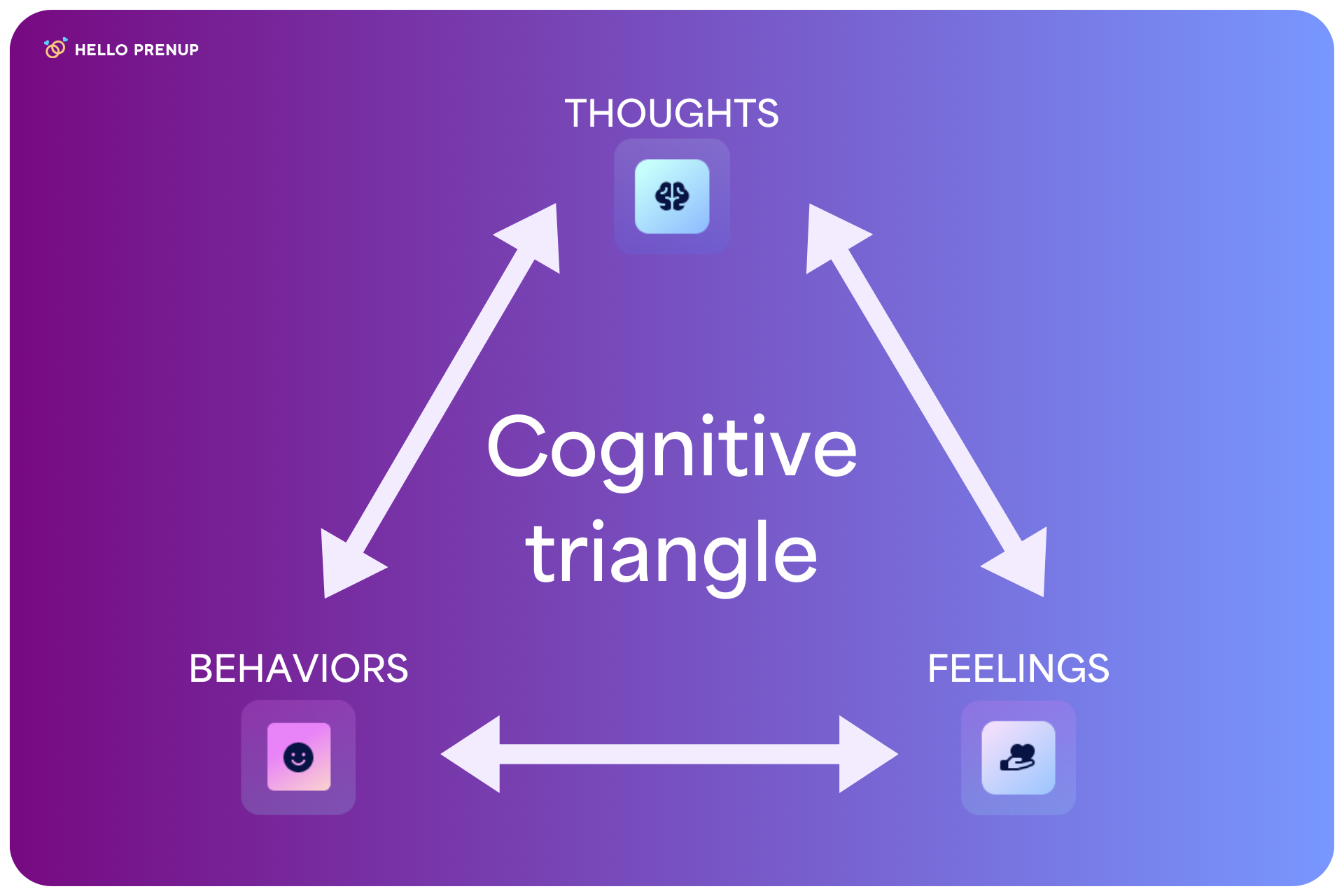
#1: Thoughts: The stories we tell ourselves
Let’s start with your thoughts. Our brains are always thinking, and thoughts are occurring even when we don’t realize it (automatic thoughts). When any situation arises, our brain offers up an idea, and, in uncertain situations, our brains can often jump to worst-case scenarios or conclusions.
In the case of cold feet, common automatic thoughts and thought patterns can include:
- Catastrophizing: “We couldn’t even figure out what color the napkins should be; our marriage is going to be a disaster.”
- Black-and-white thinking: “If I’m not excited during this whole process, then this must be a huge mistake.”
- Self-doubt: “He totally checked out the server – maybe I’m not enough for him.”
These automatic thoughts can often be exaggerated or distorted, yet they hold immense power. They spark emotional responses that can make the situation feel even more overwhelming.
#2: Feelings: The emotional ripple effect
Our thoughts directly influence our emotions. Look back at the automatic negative thoughts above. What feelings do you think will be triggered by those thoughts?
-
- Anxiety
- Fear
- Guilt
- Anger
- Sadness
These feelings are part of your body’s natural stress response; in fact, anxiety’s job is to protect us from danger. But sometimes, anxiety does too good of a job and makes a neutral or even positive experience look like a threatening situation.
#3: Behaviors: How we react
Those thoughts and feelings then flow to how we respond and react. In other words, our behaviors. When cold feet take over, you might find yourself:
-
- Avoiding tasks or conversations. Avoiding a problem is an effective strategy! There’s a reason so many of us use it. But avoiding the things that make us anxious, scared, or upset tends to make the problem bigger.
- Procrastinating. Do you ever find yourself pushing off decisions, hoping that clarity will magically appear? This is another form of avoidance.
- Over-researching. Researching… overanalyzing… to try and find the “perfect” answer to quiet your doubts.
- Blame. To understand or relieve the uncomfortable feelings, we may look for the “source” to assign blame. But our automatic thoughts or feelings can misdirect us and lead us to overblame or blame the wrong people, things, or events.
While these behaviors might temporarily relieve, they often worsen the situation by delaying resolution or creating additional stress.

How to use the cognitive triangle to help with cold feet
The cognitive triangle is more than just a framework; it’s also a practical tool for breaking free from the cold feet cycle. Since thoughts, feelings, and behaviors are interconnected, changing one corner of the triangle can positively influence the others. This means you don’t have to tackle everything at once—starting small can make a big difference.
1. Identify Your Thoughts
Practice noticing your automatic thoughts. For example, when you are deciding what music to choose for your wedding… what’s going on in your mind? Practice helps, and tools like a thought log can help build this muscle.
2. Challenge Your Thoughts
When doubts creep in, pause and ask yourself:
-
- “What’s the evidence for and against this thought?”
- “Am I jumping to conclusions or assuming the worst?”
- “What would I tell a friend who felt this way?”
- “What else might be happening instead?”
For example, if you’re thinking, “What if I’m not ready to get married?” You can reframe it as, “I’m feeling nervous about the wedding, and this is a natural reaction to a huge life change.”
3. Regulate Your Emotions
Regulating your emotions can help us avoid the behaviors that reinforce this negative cycle and help provide data to our brains that we’re okay! A few techniques:
-
- Deep breathing. Diaphragmatic breathing is the most effective way to reduce the bodily experience of anxiety and stress. These slow, intentional breaths help us slow our heart rate, reduce our blood pressure, and improve relaxation.
- Journaling. Writing down your fears can provide clarity and emotional release. This doesn’t have to be a written journal; you can also get creative and use an audio journal or video component or even draw your thoughts out!
- Mindfulness exercises. Mindfulness exercises that help ground you (like the five sense exercise) can help you remain in the present and not spiral to the unknown future. How do you do that? Take a minute and use each of your five senses (one at a time) to notice what is happening around you.
- Move your body. Physical movement can keep your mind in the present and release any emotional impacts on your body.
- Talk it out. Lean on trusted loved ones to let your feelings out. Keeping them all can make them feel bigger than they are, so processing them with a family member or friend can help alleviate that.
4. Intentional Acts
You can also attack cold feet at the “behavior” point of the cognitive triangle. What does that look like? Try:
-
- Breaking tasks into smaller steps. Focus on one thing at a time to reduce feeling overwhelmed and trigger those anxious thoughts. Need to figure out a prenup? Make the task easier by breaking it into small tasks like looking into services or lawyers who can help with a prenup, setting aside two hours to pull financial documents, or just creating a checklist of action items.
- Setting deadlines. Give yourself a clear timeline to make decisions. Share this with others that can help keep you accountable, so you’re less likely to procrastinate.
- Seeking support: Talk to a trusted friend, partner, or therapist who can offer perspective.
- Set limits. Noticing patterns or triggers for the behaviors you don’t want to do? Set boundaries. Does talking to your wedding planner trigger your cold feet more often than not? Move the correspondence to your partner or look at getting a new planner.
When are cold feet a red flag?
Sometimes, cold feet signal deeper issues that need attention. If your doubts feel persistent and specific, they might point to something requiring more exploration.
- Unresolved conflicts. Are there recurring arguments or mismatched values?
- Disproportionate negative emotions. Do you feel more dread than joy about the decision?
- No changes. Even after trying all this and more, do you still feel that something’s off?
In these cases, it’s worth pausing and seeking professional guidance. An individual therapist (or a couples therapist) can help you explore whether your hesitation is rooted in normal nerves or deeper concerns.
Final thoughts
Cold feet are a normal part of life’s big decisions. They’re not a sign that you’re making the wrong choice—they’re a sign that you’re human. By learning more about how your thoughts, feelings, and behaviors are connected, you can better understand what’s behind your cold feet and how to warm those toes right up!
So, the next time you feel those cold feet creeping in, don’t panic. Remind yourself that you have the tools to thaw those doubts and embrace what’s ahead.

Dr. Vivian Oberling is a licensed clinical psychologist with degrees from UCLA, Harvard, and Stanford. In her private telehealth practice, she works with adults navigating anxiety, identity shifts, and relationship dynamics—whether they’re dating, partnered, or parenting. She also provides executive coaching and behavioral health advisory support to tech startups and legal tools reshaping how we think about love, marriage, and psychological safety. Dr. Oberling combines 10+ years of clinical expertise with modern, real-world insight to help people move through uncertainty with clarity and connection.
0 Comments