

Casual. Formal. Black tie. Beach formal. Just opening a wedding invitation can make your head spin before you’ve even decided whether you’re going. For most people, googling whatever dress code got assigned is step one, and it’s usually enough to feel like you’ve got it handled. Unless it’s “semi-formal,” in which case Google somehow manages to make things more confusing, not less.
You know a tuxedo isn’t required, thank goodness, but you’re still not sure what actually counts as dressy enough. So now what?
If you’re standing in front of your closet trying to reverse-engineer what “semi-formal” even means, you’re not alone. Semi-formal is arguably the trickiest dress code on the wedding spectrum, precisely because it’s a range instead of a rule. It sits somewhere between business casual and black tie, which means it hands you a handful of decisions instead of a script to follow: suit or sport coat, tie or no tie, navy or grey.
So here’s what we’re covering: what semi-formal actually means, how to choose between a suit and a sport coat, why narrowing your decisions early beats a Saturday spent overshopping, which colors and patterns hold up, how fit changes how you feel walking into the room, and the small details that people register without knowing why. By the end, you’ll feel confident in your choice and ready to show up and actually enjoy the festivities.
What does “semi-formal” actually mean for men’s wedding attire?
For men, semi-formal generally translates to a suit, a collared dress shirt, and dress shoes. Most semi-formal weddings still expect a tie, though a growing number of invitations will say “tie optional” outright, so it’s worth checking the invitation or wedding website closely for that detail.
Overall, just think of it as one notch above business casual (blazer, dress pants, tie not required) and one notch below black tie (tuxedo, bow tie). The same goes for “cocktail attire”: it’s pretty much the same thing as semi-formal.
Suit or sport coat?
Okay, let’s get into the nitty gritty. Do you go with a suit, or a sport coat and dress pants? If you’re not sure what the wedding couple is aiming for, take the safe choice and default to a full suit. It’s the single safest choice for semi-formal, it never looks out of place, and it works whether the ceremony is at 2pm or 8pm. A matching jacket and trouser signal that you put real thought into the outfit without trying too hard.
When does a sport coat usually work? A sport coat paired with tailored dress trousers is the better call for outdoor, daytime, or garden-style weddings, especially between late spring and early fall. It reads more relaxed while still appropriate, as long as you skip the jeans and chinos, unless the couple has explicitly said the vibe is casual.
To help you decide, take a look at the venue and the time on the invitation. Vineyard or backyard wedding at three in the afternoon? Sport coat combo. Ballroom or hotel wedding after dark? Full suit, full stop.
Simplify your choices before you start browsing for outfits
Shopping online has been one of the greatest inventions and one of the worst. You have endless options at your fingertips, and you can browse all of them without ever leaving your couch. But that abundance comes with a catch: too much choice can lead to decision fatigue. Just one suit site alone can throw dozens of colors, cuts, and fabric weights at you before you’ve even picked a shirt.
That flood can actually work against you. A well-known set of experiments on motivation found that people given a smaller, curated set were more satisfied with what they ultimately picked, and more likely to follow through, than people handed a much larger array to sort through. In other words, having more to sort through doesn’t make people feel freer. It makes them more likely to stall or second-guess whatever they land on. If you’re curious, you can read the full study on choice overload.
So, what should you do? Pick your suit or sport coat color first, then your shirt, then stop. One or two accessories, like a tie or pocket square, is plenty. Settle those three things in one sitting, and you’re good to go.
How to incorporate colors and patterns (in an non-costumey way)
Navy and charcoal are the two colors that work across nearly any semi-formal wedding, in any season, at any hour. Lighter grey and tan lean nicely into daytime and outdoor settings, especially in spring and summer. On the other hand, black shouldn’t be a contender unless you’re actually in the wedding party (and that’s what the couple wants).
If you want to bring in some texture, keep it to one element. A subtle windowpane check or a textured weave on the jacket, paired with a solid shirt, looks deliberate. Stack a patterned tie on top of a patterned shirt on top of a patterned pocket square, though, and it stops looking like an outfit and starts looking like a costume you’re trying on for the first time in the store.
A good rule of thumb: pick one piece to carry the personality, whether that’s the jacket, the tie, or the pocket square, and let everything else stay solid and simple.
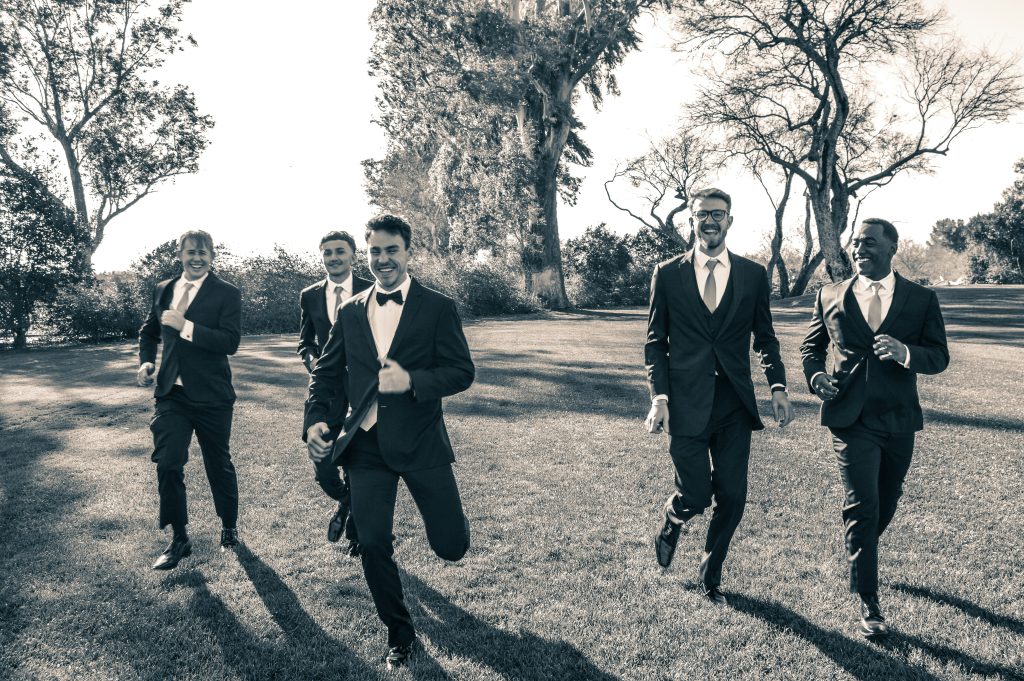
Fit, fit, fit.
So, a great suit doesn’t mean that it has to be an expensive suit. Most of the time, a well-tailored piece does more than a higher price tage. A modestly priced suit that is tailored to your shoulders, with the right sleeve length and trouser break, will beat an expensive suit pulled straight off the rack every single time.
There’s actually a psychological side to this: “enclothed cognition.” The research behind it is pretty interesting: what you wear doesn’t just change how other people see you; it changes how you feel and think while you’re wearing it. A related line of research on formal clothing found that people who wore more structured attire reported a stronger sense of personal power and slipped into more confident, big-picture thinking mode than when they were dressed down, a finding covered in this study on the cognitive effects of formal clothing.
So, the takeaway? Dressing sharp isn’t (just) about vanity, it’s about giving yourself a boost of confidence. What you do with that boost of confidence is then up to you: giving that toast, stepping out of your comfort zone and meeting new people, or being relaxed enough to enjoy the dance floor. So, find a tailor and get the jacket shoulders right first, make sure the sleeve ends where they’re supposed to, and let the trouser hem just kiss the top of your shoe.
The details: Shoes and accessories
For a semi-formal event, the shoes should walk the walk. We’re talking leather dress shoes, oxfords, derbies, or loafers, in brown or black, matched to your belt. Sorry, but sneakers (even the expensive “dressy” ones) still fall under “underdressed” for this dress code.
It’s tempting to overlook this detail, but it can actually make a big difference. A well-chosen shoe or accessory, like a belt, pocket square, or tie, can help you land squarely in the semi-formal category while still letting your own style come through in a sea of suits. Just keep the rest simple: a watch, a pocket square if you want a bit of personality, and a tie or bow tie if the dress code calls for one.
Dressing for the environment
As you can imagine, semi-formal shifts a bit depending on where and when the wedding is. For an outdoor, daytime, or warm-weather wedding, go with lighter fabrics like linen blends or lightweight wool, lighter colors, and consider skipping the tie if the invitation allows it. For an evening or indoor wedding, you can lean into richer colors and heavier fabric without worrying about sweating through the jacket before cocktail hour even starts.
The venue can also help you decide what’s appropriate. Do a quick Google search to get a visual: a barn wedding and a ballroom wedding can both technically say “semi-formal” on the invite and mean fairly different things once you actually walk in the door.
Semi-formal wedding wear for men, wrapped up
So, to sum it all up, if you’re heading to a wedding and the dress code is “semi-formal” default to a suit unless the venue clearly calls for a sport coat, stick with navy, charcoal, grey, or tan, keep patterns to one piece, prioritize fit over price tag, and don’t skip the shoes and accessories. Check the venue and time of day before you commit to anything, and try not to get stuck overshopping. A few solid decisions made early will always beat forty tabs open on your laptop the night before.
At the end of the day, semi-formal isn’t as complicated as the name makes it sound. It’s just asking you to show up looking like you put in a little effort, without going full tux or showing up in sneakers. Get the fit right, keep the colors and patterns simple, and you’ll be dressed appropriately for pretty much any semi-formal wedding that comes your way, no overthinking required.

Dr. Vivian Oberling is a licensed clinical psychologist with degrees from UCLA, Harvard, and Stanford. In her private telehealth practice, she works with adults navigating anxiety, identity shifts, and relationship dynamics—whether they’re dating, partnered, or parenting. She also provides executive coaching and behavioral health advisory support to tech startups and legal tools reshaping how we think about love, marriage, and psychological safety. Dr. Oberling combines 10+ years of clinical expertise with modern, real-world insight to help people move through uncertainty with clarity and connection.
0 Comments