
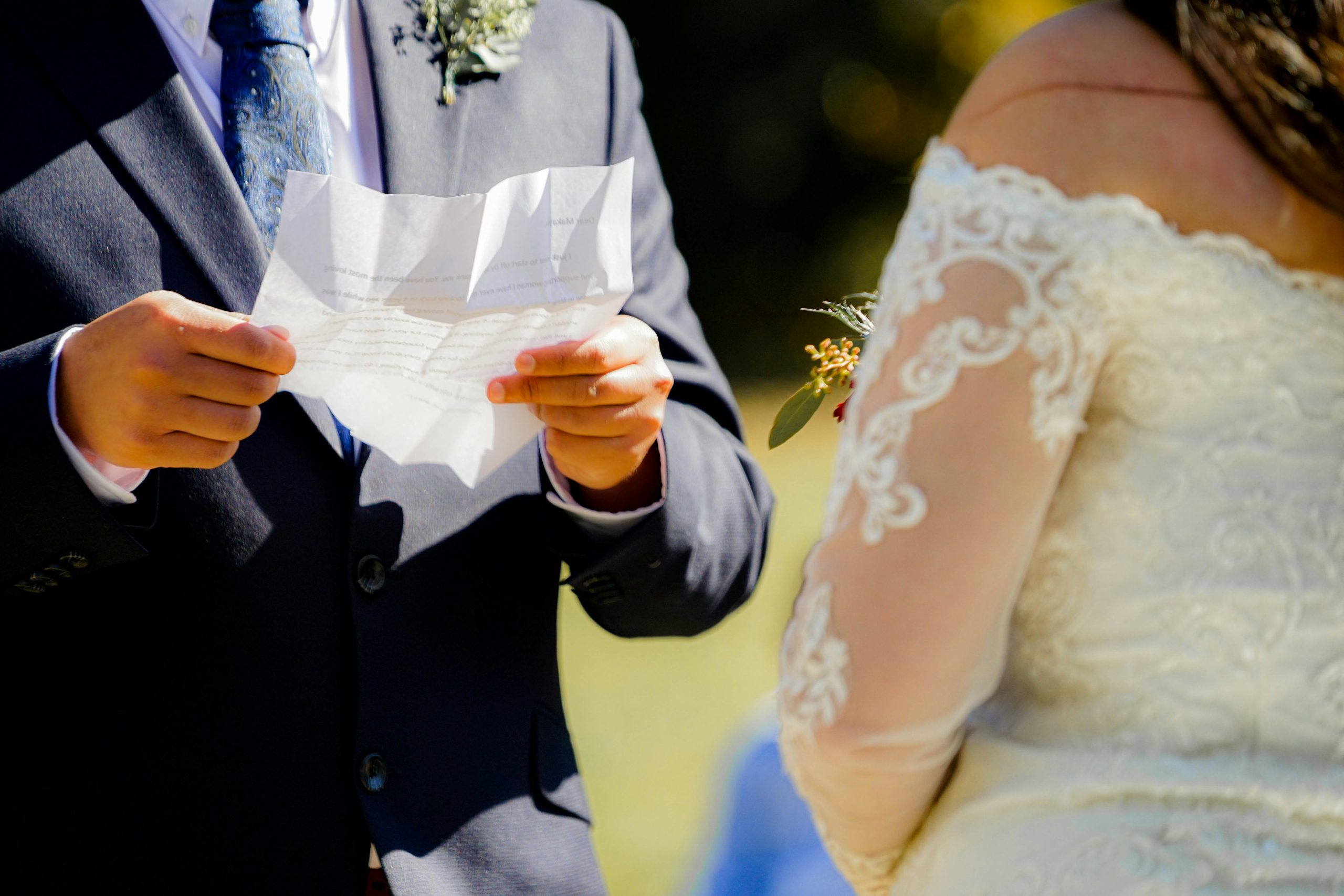
For many couples, crafting vows becomes this odd cocktail of pressure, vulnerability, and stage fright. You want to be heartfelt, but not cheesy; meaningful, but not melodramatic; personal, but not so personal considering you’re saying this in front of an audience.
Here’s the good news: you don’t have to be a poet or writer to write your wedding vows. You just have to take some time to understand your relationship, put into words what you’re promising, and be genuine. And while the process can feel intimidating, it can also bring you closer as a couple.
In this article, we’ll explore why writing your own vows can be so meaningful, how to gather and shape what you want to say so it feels true to you, what common pitfalls to avoid, and how to deliver your vows in a way that feels grounded and natural.
The psychological benefits of writing your vows
Writing your own vows has a positive psychological impact. It helps clarify how you see your partner, how you understand yourself in the relationship, and what kind of future you’re choosing together. Turning those intentions into words strengthens the relationship’s foundation, creating more commitment and emotional security.
Research on commitment rituals shows that naming shared meaning increases trust and closeness. That’s why writing vows often brings up strong emotions. It’s not just sentimental, it’s an active step into your shared identity as a couple.
The emotional experience
Writing vows can stir up big emotions, and that’s completely normal. The process asks you to reflect on your partner, yourself, and your relationship. Oh, and to also think about all your hopes and dreams for and with each other. Most of us don’t slow down to think about those things very often, so it makes sense if a wide range of feelings starts to surface.
If you feel pressure, emotion, or even get a little teary while writing, it’s not a sign that something’s wrong. It’s a sign that this moment matters. And that’s precisely what makes it meaningful.
Start by collecting stories
Most vow panic comes from the pressure to have the words immediately and to write a final draft in one or two sittings. Instead, approach this like a research project. Start by gathering material before worrying about polish. A few prompts to help you begin:
- When did you first know your partner was someone you could build a life with?
- What qualities in them have reshaped you for the better?
- How do they show love in ordinary, daily moments?
- What parts of your relationship have required courage or growth?
- What kind of partner do you want to be for them?
- What do you hope your future feels like?
At this stage, focus on moments rather than wording. Broad statements like “I love how you support me” are meaningful, but concrete examples carry more emotional weight. “You always warm up the passenger seat in winter because you know I hate sitting down in the cold” feels personal because it’s specific.
Look for the micro-moments that define your relationship. Those small, consistent actions reveal how love shows up day to day; they’re gold for vows.
Set the tone before you write the words
Every couple has a natural communication style. Some are deeply sincere, some playful, and others a little sarcastic. Keep that in mind as you write. Your vows should sound like you as a couple, not like something pulled from a generic template.
While the exact wording is usually kept private until the wedding day, it’s helpful to discuss the overall tone with your partner. Do you want your vows to feel romantic, grounded, funny with heart, poetic, simple, or a blend of styles? They don’t need to match perfectly, but they should live in the same emotional neighborhood.
This conversation also helps prevent the classic mismatch: one partner delivering two minutes of heartfelt sincerity while the other launches into a stand-up routine. Both styles can be wonderful, just maybe not at the same time.
Shape the content with a simple framework
Once you have content and the tone down, you can start shaping the vows into something with structure.
Start with a grounding moment. Something like how you met, when you knew you loved them, or what you admire about who they are. This brings guests into your story and helps you ease into the rest of your vows.
Share what you love in concrete details. Focus on moments you can picture rather than big, abstract words. Small, real examples make vows feel personal and lived-in, rather than vague or generic.
Name the ways your relationship has changed you. When you talk about how your relationship has helped you grow or change, it adds depth to your vows.
Include clear, heartfelt promises. These are the backbone of your vows. Make them specific, realistic, and rooted in the kind of partnership you’re building. Promising that you’ll never fight is just unrealistic, but promising to repair after conflict feels more human and achievable.
End with a future-oriented statement. Something about what you hope to create together ties it all together.
This simple structure helps your vows feel thoughtful and balanced, without overthinking every word or trying to make them perfect.
Make promises you can actually honor
Even though we touched on this earlier, it’s important enough to deserve its own section.
Weddings mark the start of a new chapter, and the emotional high and optimism that come with that are genuinely beautiful. But making promises that you or anyone else can’t realistically keep can unintentionally set you up for disappointment.
The goal isn’t to tone down the hope. It’s to shape it in a healthy, sustainable way. Here are the kinds of promises that are good to focus in on:
- How you want to approach conflict
- How you hope to support your partner emotionally
- How you’ll protect the relationship during stressful seasons
- How you want to stay connected over the long term
- How you’ll honor individuality and shared identity
- What you commit to practicing over and over again
These types of promises mirror the protective factors that we know support long-term relationships: emotional responsiveness, shared meaning, collaborative problem-solving, and small daily bids for connection.
What to avoid in your vows
There’s a lot of freedom in vow-writing, but it helps to remember these words will be shared in front of your loved ones and maybe a few people you don’t know that well, but still made the guest list. With that in mind, there are a few helpful no-fly zones to consider.
Try to avoid inside jokes that no one else will understand unless they truly stand on their own. Skip embarrassingly intimate details, and steer clear of promises that erase individuality, like “I’ll never let you feel sad again.” Also, avoid turning vows into a subtle roast. Playful teasing has its place, but your vows aren’t it.
Don’t overthink the length
Wedding vows aren’t meant to be a TED Talk. The sweet spot is usually one to three minutes. Much shorter can feel incomplete, while much longer can be hard to deliver.
Once you have a draft, read it out loud to check the timing. Most people are surprised by how quickly a page goes when spoken or how long it can feel once emotion and pauses are added.
Practice your vows out loud
You don’t need to memorize your vows or add any dramatic flair, but it helps to read them out loud a few times before the ceremony.
Saying the words out loud isn’t just about timing. It helps you catch phrasing that sounds stiff when spoken and prepares you for emotional moments. If the same line makes you tear up every time, that’s useful to know. You can decide whether to keep it or adjust it so the moment feels more manageable.
Practicing also helps calm nerves. When the words are familiar, they feel less overwhelming, which makes it easier to stay present when you’re actually standing there saying them.
What to do if you’re hit a writer’s block
If you find yourself staring at the page with a sense of dread, try switching to a different approach. Write a letter to your partner, record a voice memo talking about them, or even talk it through with a trusted friend. Share what you hope their life feels like with you, what you want them to know deep down, and the kind of love you’re trying to build together.
Changing the format takes some of the pressure off and helps you speak from a more natural place. And remember, your vows don’t need to capture every part of your relationship. They just need to tell the truth about how you love this person and how you plan to keep showing up for them.
A final word on writing your vows
At the end of the day, wedding vows aren’t a performance or a test of your writing skills. They’re a moment of intention and reflection, and a chance to put words to what you feel and live every day with your partner. When you take time to reflect on your relationship, name what you’re committing to, and shape those promises in a way that feels honest, the process itself becomes meaningful.
If your vows feel sincere, specific, and genuine to how you love, they’re doing their job. They don’t need to be perfect. They don’t need to sound impressive. They just need to sound like you.

Dr. Vivian Oberling is a licensed clinical psychologist with degrees from UCLA, Harvard, and Stanford. In her private telehealth practice, she works with adults navigating anxiety, identity shifts, and relationship dynamics—whether they’re dating, partnered, or parenting. She also provides executive coaching and behavioral health advisory support to tech startups and legal tools reshaping how we think about love, marriage, and psychological safety. Dr. Oberling combines 10+ years of clinical expertise with modern, real-world insight to help people move through uncertainty with clarity and connection.
0 Comments